DeepSeek V4 Flash 0731: How Better Training Beat a Bigger Model
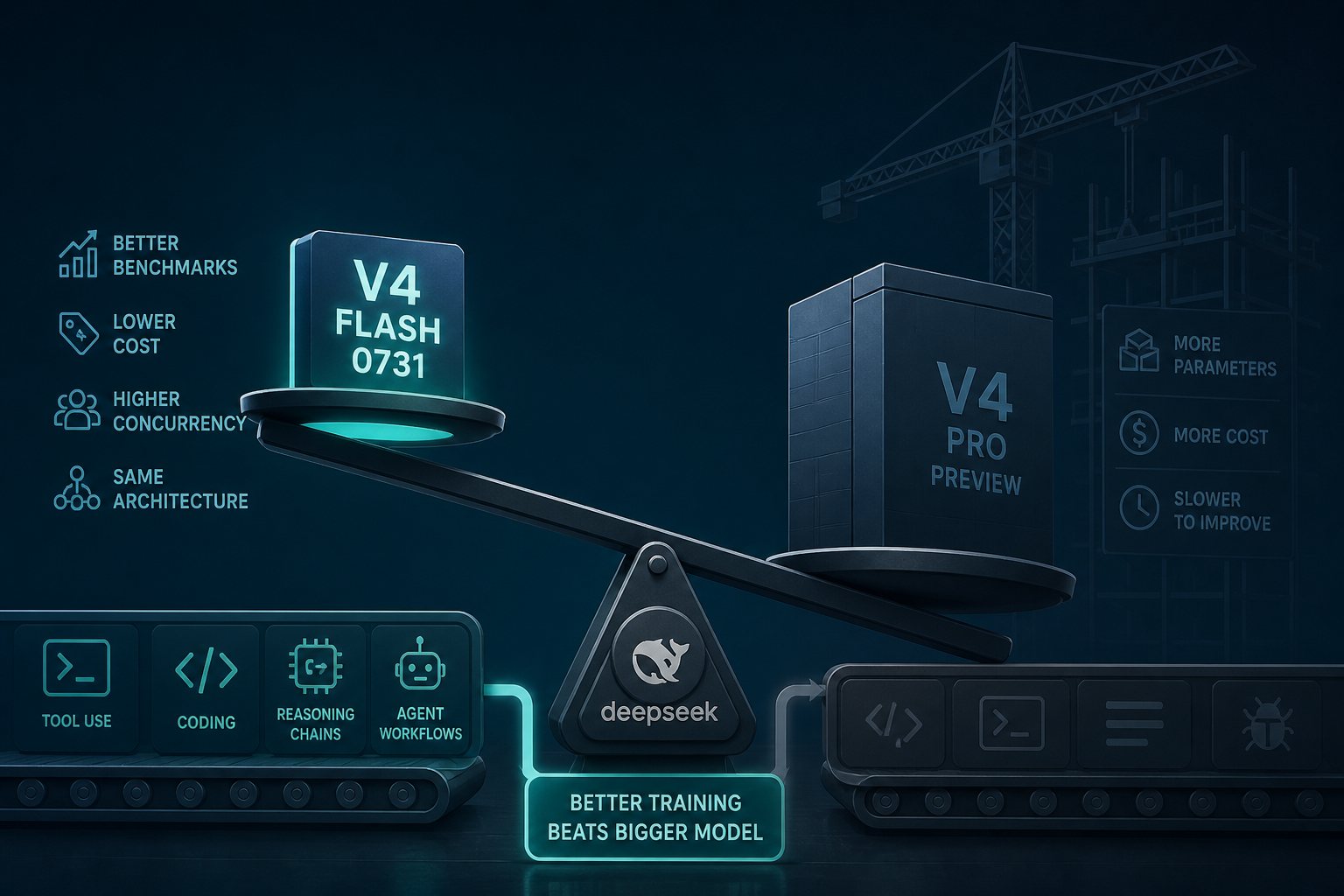
On July 31, 2026, DeepSeek quietly made a loud point: you don't need a bigger model to build a better one. The company released DeepSeek-V4-Flash-0731 — the official production version of its Flash API — and the headline buried in the release notes is that this budget model now outperforms DeepSeek's own V4-Pro-Preview on every agentic and coding benchmark the company published. The architecture is identical. The only change was retraining.
What Actually Changed
The V4 Flash model has been available in preview since April 2026. The 0731 build is described by DeepSeek as "was only re-post-trained" — same 284-billion-parameter mixture-of-experts architecture, same 13 billion active parameters per forward pass, same one-million-token context window. What changed is the post-training pipeline: the team focused it heavily on tool use, coding, reasoning chains, and autonomous agent workflows.
The results suggest post-training quality now moves the needle more than raw parameter count. On Terminal Bench 2.1 — which measures a model's ability to complete real terminal-based software tasks — V4-Flash-0731 scores 82.7 against V4-Pro-Preview's 72.1, a 14.7% margin in favor of the smaller, cheaper model. Other vendor-reported scores: DeepSWE (repository issue resolution) at 54.4, Toolathlon (multi-tool execution) at 70.3, and DSBench FullStack at 68.7. Independent benchmarker Artificial Analysis places V4-Flash-0731 at 50 on its Intelligence Index, a 10-point jump over the April Preview build and a 6-point lead over V4-Pro — which sits at 44.
A few honest caveats before reading too much into those numbers: several of the benchmark tests run on DeepSeek's own internal harness with no public reproduction. The two DSBench evaluations are internal datasets. Terminal Bench results require a "minimal mode" component that DeepSeek hasn't released. Treat the vendor scores as directional, not gospel. What Artificial Analysis measured independently — the 10-point Intelligence Index jump — is the number with the most credibility.
The Pricing Gap Is Harder to Argue With
Benchmark disagreements aside, pricing is straightforward. V4-Flash-0731 bills at $0.14 per million input tokens and $0.28 per million output tokens on DeepSeek's first-party API. Cached input drops to $0.0028 per million — a 98% discount that matters enormously for agent loops that re-read the same context repeatedly.
For comparison, GPT-5.6 Luna sits at 51 on Artificial Analysis's Intelligence Index — one point ahead of V4-Flash-0731. After OpenAI's recent 80% price cut on Luna, Artificial Analysis calculates DeepSeek's cost per task still comes in roughly 60% lower. That's a meaningful gap at any serious usage volume. A 20-million-token agent run (a realistic size for a multi-step coding task with large context) costs approximately $3.50 on V4 Flash before cache benefits kick in.
One operational detail worth noting: Flash supports 2,500 concurrent API requests versus 500 for Pro — a 5x capacity advantage that matters if you're running parallel agent jobs. DeepSeek has announced a future peak/off-peak pricing policy that will double rates during Beijing-time business hours, but the implementation date is not set.
What Businesses Should Actually Do With This
The model is well-suited to tasks where the output can be mechanically verified and mistakes are reversible: code migrations with deterministic test suites, issue triage pipelines, large-scale prompt evaluation runs, and draft generation for human review workflows. These are exactly the workloads where agentic loops earn their keep and where the cost savings compound.
The model is a worse fit for production incident response, any automation with real-world side effects, and security-sensitive workflows. Output verbosity is notable — Artificial Analysis measured V4-Flash-0731 generating output tokens at roughly 3.4 times the median rate of comparable models. That affects latency and, on uncached runs, adds cost on the output side. For interactive or latency-sensitive pipelines, benchmark against your actual task shapes before committing.
The open-weights situation is also unresolved: as of this writing, no V4-Flash-0731 repository has appeared on Hugging Face. The April Preview weights are still the only open-weight version available. If you need to self-host, you're waiting.
The Bigger Pattern
This release is one more data point in a trend that's reshaping how AI labs compete: post-training has become the primary battleground. Adding parameters is expensive and slow. Refining the training pipeline — reinforcement learning from human feedback, synthetic data, better reward signals for tool use — can be iterated quickly and applied to existing architectures. DeepSeek did exactly that, turned a preview model into something that outperforms its own flagship on the tasks that matter for agents, and held the price flat.
Kimi K3 from Moonshot AI, which launched in mid-July with 2.8 trillion total parameters, still leads the open-source agentic leaderboard with a GDPval-AA v2 Elo of 1687 against V4-Flash-0731's 1559. But K3 wins with scale; V4-Flash wins with economics. As 2026 rolls on, the interesting AI race isn't raw capability — it's who can push the quality-per-dollar frontier further, faster. DeepSeek just moved the line.
We route a meaningful share of our own internal automation through agentic pipelines, so we watch these releases closely. The lesson this one reinforces: pick the model for the workload, not the benchmark headline, and always measure cost per completed task on your own data before locking in.