4,300 Fake FIFA Sites Are Live. Brief Your Staff Before June 11.
The whistle blows June 11. Before then, the FBI wants a word with your employees.
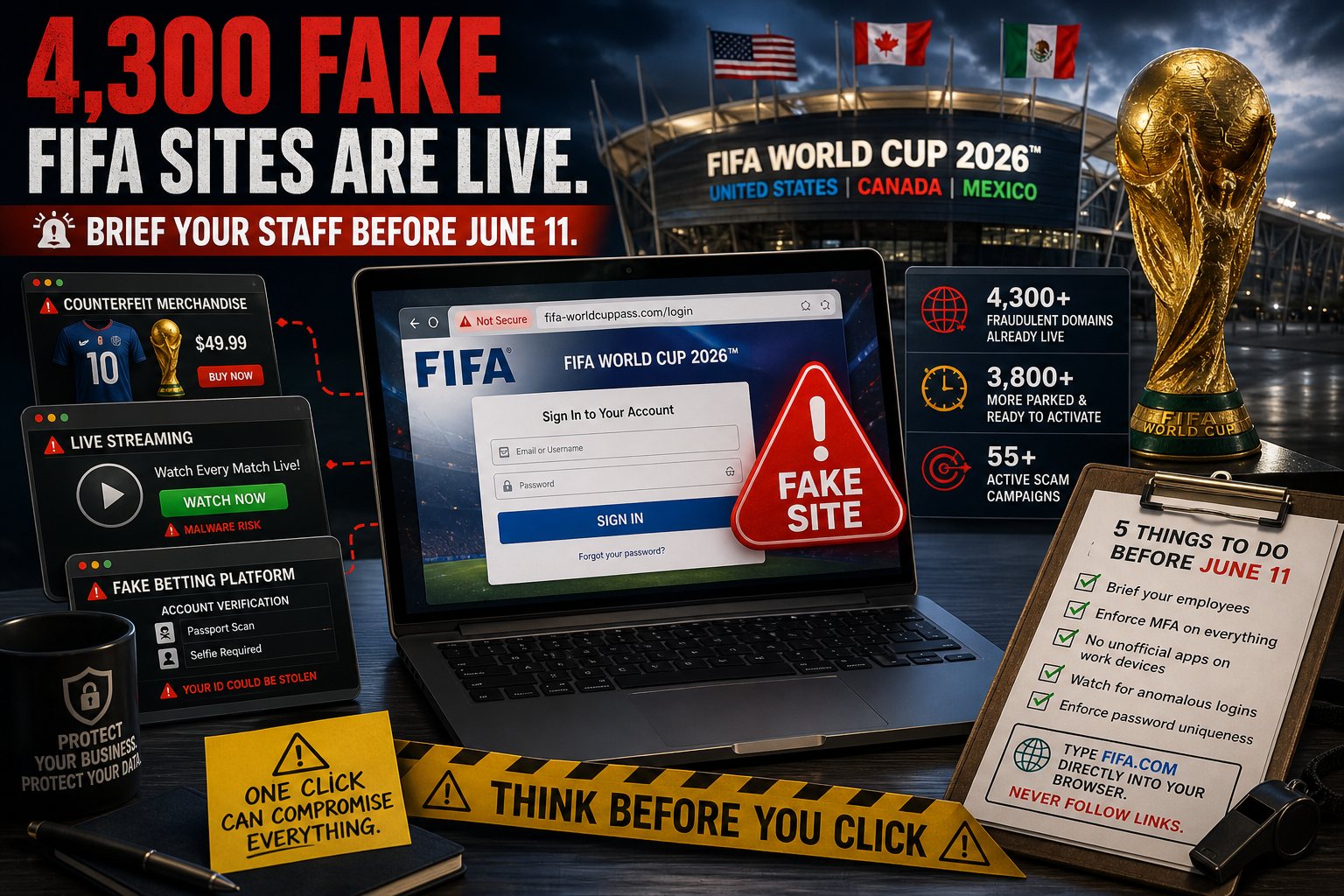
The agency's Internet Crime Complaint Center published PSA260527 on May 27, warning that threat actors have built a sprawling fraud infrastructure around World Cup 2026. Research firm Group-IB tracked more than 4,300 fraudulent FIFA-branded domains registered since last August, with roughly 3,800 more parked and ready to activate. Bitdefender logged 55-plus active scam campaigns targeting fans as of early June. The tournament runs June 11 through July 19 across the United States, Canada, and Mexico.
It's Not Just Ticket Fraud
The popular image of a sports scam is someone hawking fake tickets. This operation is more layered. Group-IB identified four distinct attack tracks:
- Credential-harvest pages — pixel-perfect copies of FIFA's login screen that steal usernames and passwords
- Malware-dropping streaming sites — take your subscription fee, then silently install banking malware
- Counterfeit merchandise shops — collect card numbers and shipping addresses
- Fake betting platforms — demand passport scans and selfies for "account verification," then sell the identity data
Each path ends the same way: an attacker walks away with something — a password, a banking session token, a card number, a photo ID — that has value long after the final whistle.
Why Your Business Is in the Blast Radius
Someone who clicks a fake FIFA link on a work laptop, installs an unofficial streaming app on a company machine, or reuses their corporate email password on a fraudulent site has just handed an attacker a business foothold. The fraud campaign runs 38 days — and the 2026 Verizon Data Breach Investigations Report found the median time to fully remediate a known vulnerability is already 43 days. The overlap is not a coincidence attackers will miss.
Credential theft and phishing remain the two most reliable ransomware entry points. Mass social-engineering events like a World Cup are exactly when opportunistic attackers sharpen targeting, because awareness is split between work and the match score.
Five Things to Do Before Thursday
- Brief employees today. A five-minute heads-up — "there are thousands of fake FIFA sites; verify the URL before entering any credentials" — prevents most of this.
- Enforce MFA on everything. If a password gets stolen from a lookalike site, multi-factor authentication is what stops it from becoming a business breach.
- No unofficial apps on work devices. If it didn't come from a recognized app store, it has no business running on a company machine.
- Watch for anomalous logins. New country, odd hours, unfamiliar device — treat every unusual access during the World Cup window as suspect until verified.
- Enforce password uniqueness. A password manager generating unique credentials per site is the most cost-effective security control most small businesses can deploy right now.
The FBI's specific guidance: type fifa.com directly into the browser — never follow a search result or email link. That single habit kills lookalike-domain attacks dead.
At Falcon Internet, 24x7x365 NOC monitoring flags anomalous access before it escalates. Monitoring only helps, though, if the credential wasn't already compromised upstream — and upstream protection starts with a five-minute conversation with your team today.