Qilin Hit the ATF. Small Businesses Are Its Real Target.
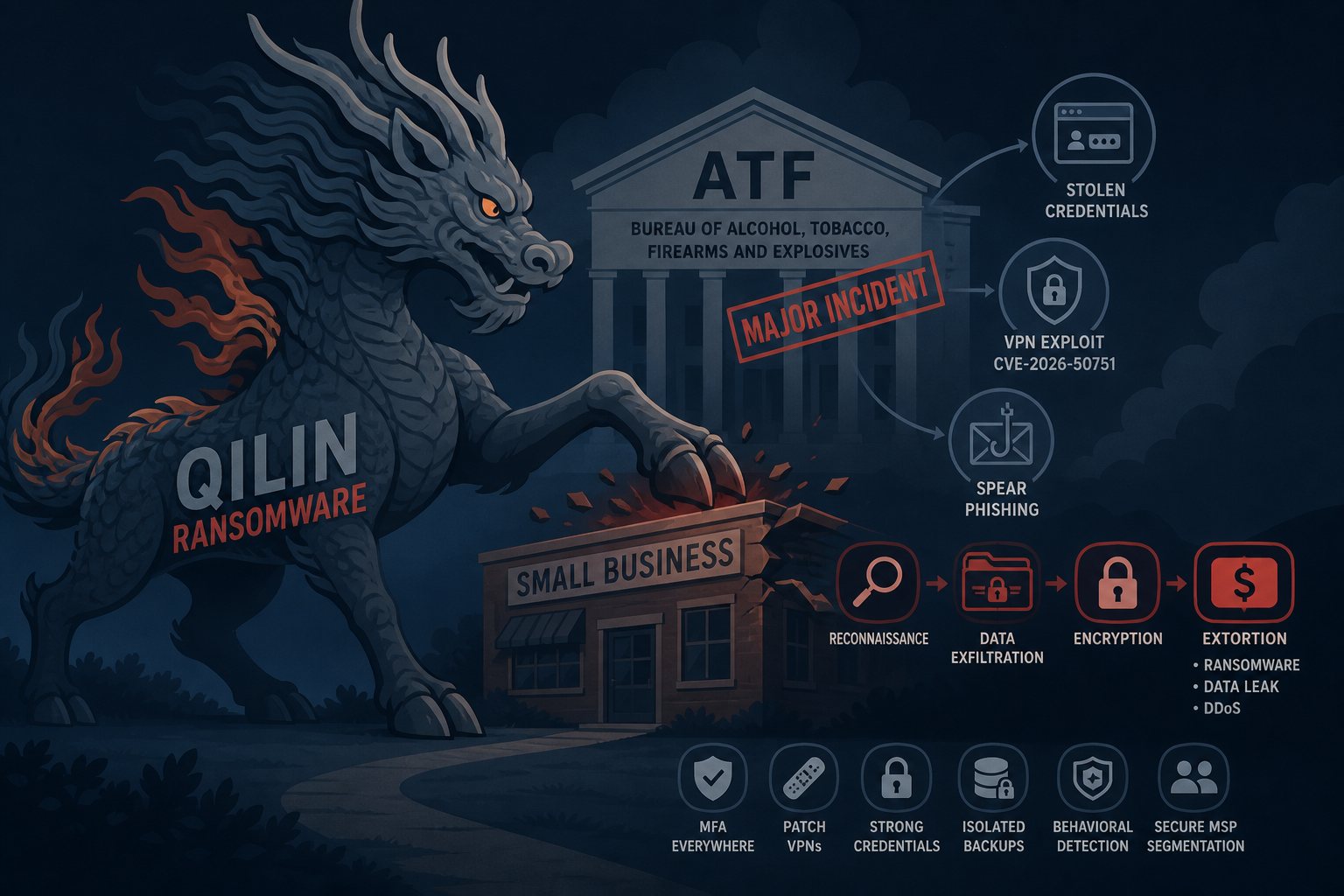
On August 27, the U.S. Bureau of Alcohol, Tobacco, Firearms and Explosives declared a “major incident” — the formal, congressionally notified classification — after the Qilin ransomware gang posted the agency to its dark web leak site. ATF said the compromised system contained data on active investigation targets and operated separately from its enterprise network; no evidence of broader damage has emerged. Qilin provided no proof of its claim, and attribution remains unconfirmed.
Headlines will run with the federal-agency angle. That misses the point. Qilin hitting a government agency is the exception. Qilin hitting businesses like yours is the routine.
The Numbers Don’t Lie: Qilin Prefers Small Targets
Qilin — also tracked as Agenda — first emerged in 2022 as a Go-based ransomware platform before being rewritten in Rust for speed and portability. It operates as ransomware-as-a-service (RaaS): the core group builds the tools and manages the leak site; affiliates rent the infrastructure, conduct intrusions, and split ransom payments with the developers. That franchise model is why activity scales so fast and why affiliate tactics vary.
The 2026 numbers are striking. Black Kite tracked 7,551 publicly disclosed ransomware victims globally in 2026, with Qilin accounting for 1,358 of them — a 443% year-over-year increase from roughly 250 victims the prior year. Cyble Research and Intelligence Labs named Qilin the most active ransomware operation in their H1 2026 dataset, logging approximately 370 North American attacks. Moxfive tracking puts the group’s total claimed victims above 1,500 since launch, with more than 500 in 2026 alone.
Here is the number that matters most for small businesses: 67% of confirmed Qilin victims employ fewer than 200 people. This group is not chasing Fortune 500 paydays. Their model is volume: breach dozens of organizations that lack mature security programs, collect mid-five-to-six-figure ransoms, and repeat. Manufacturing is their most-targeted vertical, followed by professional services, healthcare, technology, and construction.
How Qilin Gets In
Qilin intrusions are human-operated, not automated spray-and-pray. Affiliates study targets and select entry methods deliberately. Two initial-access vectors dominate their playbook.
The first is credential-based access. Stolen passwords and session tokens circulate constantly on dark web markets — sourced from infostealer logs, old breach dumps, phishing hauls sold to multiple buyers. Qilin affiliates use these to authenticate directly to exposed VPN portals and RDP endpoints, bypassing the need to exploit anything. If your staff reuse passwords or your remote access lacks MFA, you are one stolen credential away from an intrusion.
The second is direct VPN exploitation. CVE-2026-50751 is a CVSS 9.3 authentication bypass in Check Point VPN Remote Access and Mobile Access that became a confirmed Qilin initial-access vector starting May 7, 2026. The flaw allows an unauthenticated attacker to skip password authentication entirely by exploiting a logic error in certificate validation — but only on gateways still configured with the deprecated IKEv1 key-exchange protocol. Qilin affiliates exploited this as a zero-day for weeks before a patch existed. Check Point has since issued a fix, but organizations running IKEv1 and behind on updates remain exposed.
Targeted phishing — spear-phishing emails aimed at finance and IT staff — remains a supplementary vector, particularly at firms without active security awareness training programs.
What Happens After the Door Opens
Qilin affiliates take their time once inside. The attack chain runs in phases: credential harvesting, network reconnaissance, lateral movement toward backup systems and domain controllers, data exfiltration — and only then ransomware deployment. That sequencing is deliberate. By the time files are encrypted, the stolen data is already off-premises, which means organizations that restore from backup still face extortion over what was exfiltrated.
Two newer capabilities complicate defense further. Affiliates have been observed deploying Linux encryptors through Windows Subsystem for Linux (WSL), executing the payload while evading Windows-native endpoint detection tools that don’t inspect WSL process trees. Qilin also added a DDoS module to its toolkit in 2025, giving operators a third extortion lever: flood internet connectivity while files are encrypted and a data-leak clock is running.
Managed service providers are a priority target. Compromising an MSP yields access to every downstream client through a single intrusion. Small businesses that rely on outsourced IT management should ask their providers directly what network segmentation limits lateral movement to client environments — and press for a real answer, not marketing language.
What Your Business Should Do Right Now
- Audit your remote access surface. Any VPN portal, RDP endpoint, or web-facing admin panel with a weak or reused password is a potential Qilin entry point. Inventory them and require MFA on all of them, no exceptions.
- Patch VPN appliances — especially Check Point. If you run Check Point Security Gateways, confirm CVE-2026-50751 is patched and disable IKEv1. There is no operational reason to keep a deprecated protocol that is actively weaponized.
- Harden administrative credentials. Privileged accounts need unique, long passphrases stored in a password manager, protected by MFA, and never used for routine work. Credential reuse at the admin level is how lateral movement becomes domain compromise in under an hour.
- Isolate your backups. Qilin affiliates specifically target backup infrastructure before triggering encryption. Offsite, immutable backups that survive a Safe Mode reboot and cannot be deleted or encrypted from the primary environment are the minimum viable posture. Test restores — not just backup jobs.
- Ask your IT provider hard questions. If you use an MSP, push for specifics on how their internal infrastructure is segmented from client environments. A compromised MSP with no separation is an open door to your data.
- Deploy behavioral endpoint detection. Signature-based antivirus does not catch WSL-based encryptors. Behavioral EDR tuned to detect unusual process trees, memory access patterns, and mass file operations is the layer that catches what traditional AV misses.
Qilin will not make the evening news the next time it hits a 40-person professional services firm. The ATF story fades; the ransomware group does not. At Falcon Internet, production restores are rehearsed — not because we expect to need them, but because organizations that never practice are the ones that discover, at the worst possible moment, that theory and execution are entirely different things.