"Chat Is Dead": Inside OpenAI's Pre-IPO Pivot to Agents
According to the Financial Times, the roughly $850 billion company behind ChatGPT is preparing the biggest overhaul of the product since it kicked off the AI boom in 2022 — and the timing isn't subtle. OpenAI is reportedly planning an IPO this year, and it needs a clearer path to profit to pitch investors.
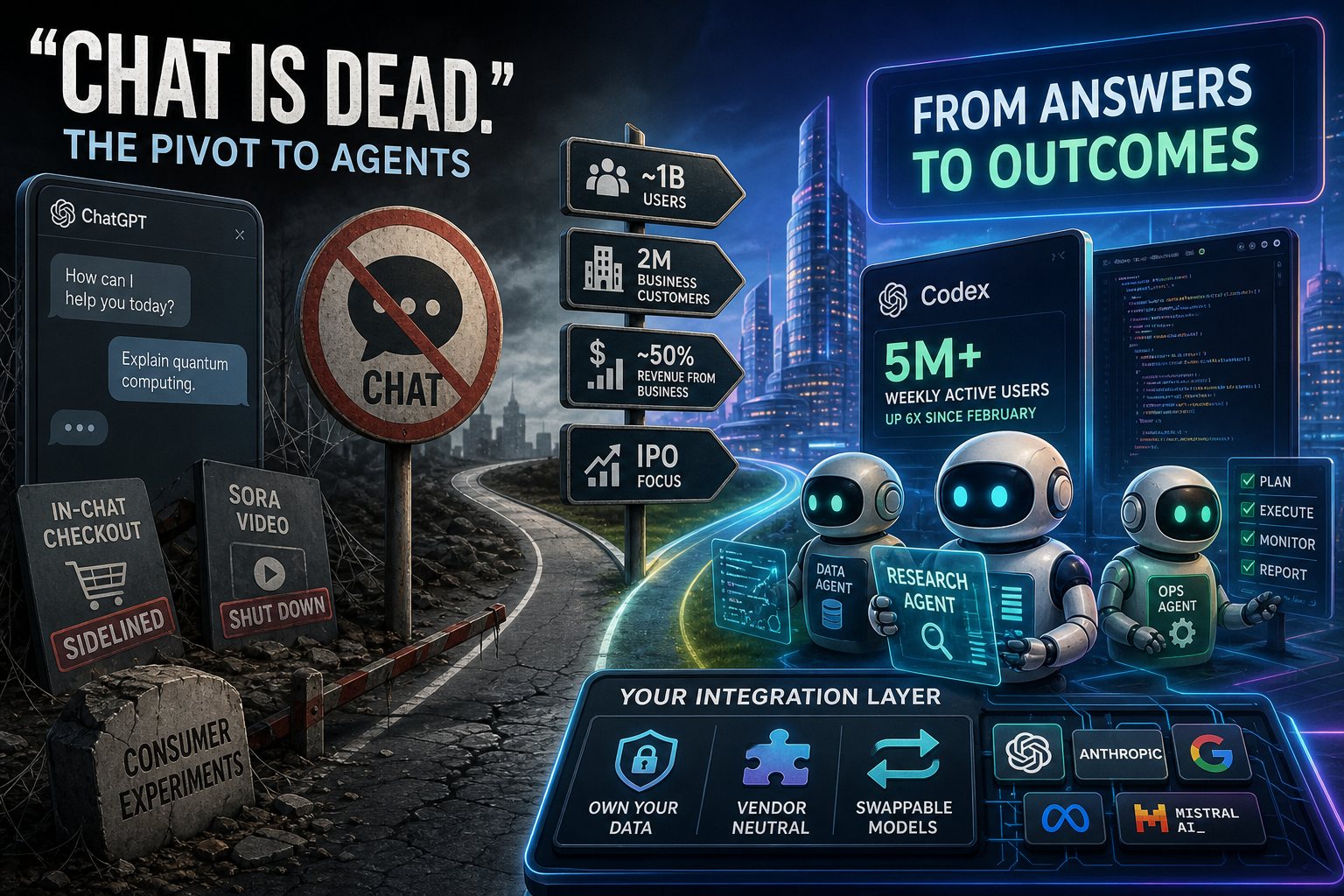
The plan: turn ChatGPT into a "superapp" that funnels its nearly one billion users — most of whom pay nothing — toward higher-margin products. Coding tool Codex (now past 5 million weekly active users, up sixfold since February) gets top billing, alongside AI agents that do tasks rather than just answer questions. One senior employee's summary, per the FT: "Chat is dead."
The real story: strategy convergence
OpenAI is reorganizing around business customers — the ~2 million companies using its products already drive about 40% of revenue, projected to hit 50% by year-end. That's a deliberate move toward the enterprise-first playbook its rival Anthropic has used to grow fast. As one former OpenAI researcher put it: both are now "trying to aim for an IPO, and investors care more about money than dreams."
To get there, OpenAI is sunsetting consumer bets. The in-chat checkout feature is being sidelined; Sora, its video product, was shut down less than a year after launch.
The signal for everyone building on AI
That last detail is the one businesses should sit with. A flagship product from the most-watched company in tech was launched and killed inside twelve months — because the IPO math changed. If your product or workflow depends on a specific AI vendor's feature, the lesson is plain: vendor roadmaps now turn on quarterly financial pressure, not your needs.
- Own your integration layer. Treat any AI provider as a swappable component behind your own abstraction, not a foundation poured into your codebase.
- Keep your data yours. Whatever the model, the customer data, prompts, and outputs should live in infrastructure you control.
- Expect the pivot. Agents and coding tools are clearly where the money is heading — build toward that, but assume today's API is not forever.
We build AI features into client applications regularly, and this is exactly why we design them vendor-neutral — the useful capability wired in cleanly, the data and the business logic kept on infrastructure we run and monitor 24x7x365. Models will keep changing faster than anyone's roadmap promises. Your architecture shouldn't have to.