34% of Laravel Apps Have Critical Flaws — A 2026 Study of 10,000 Sites Shows Why
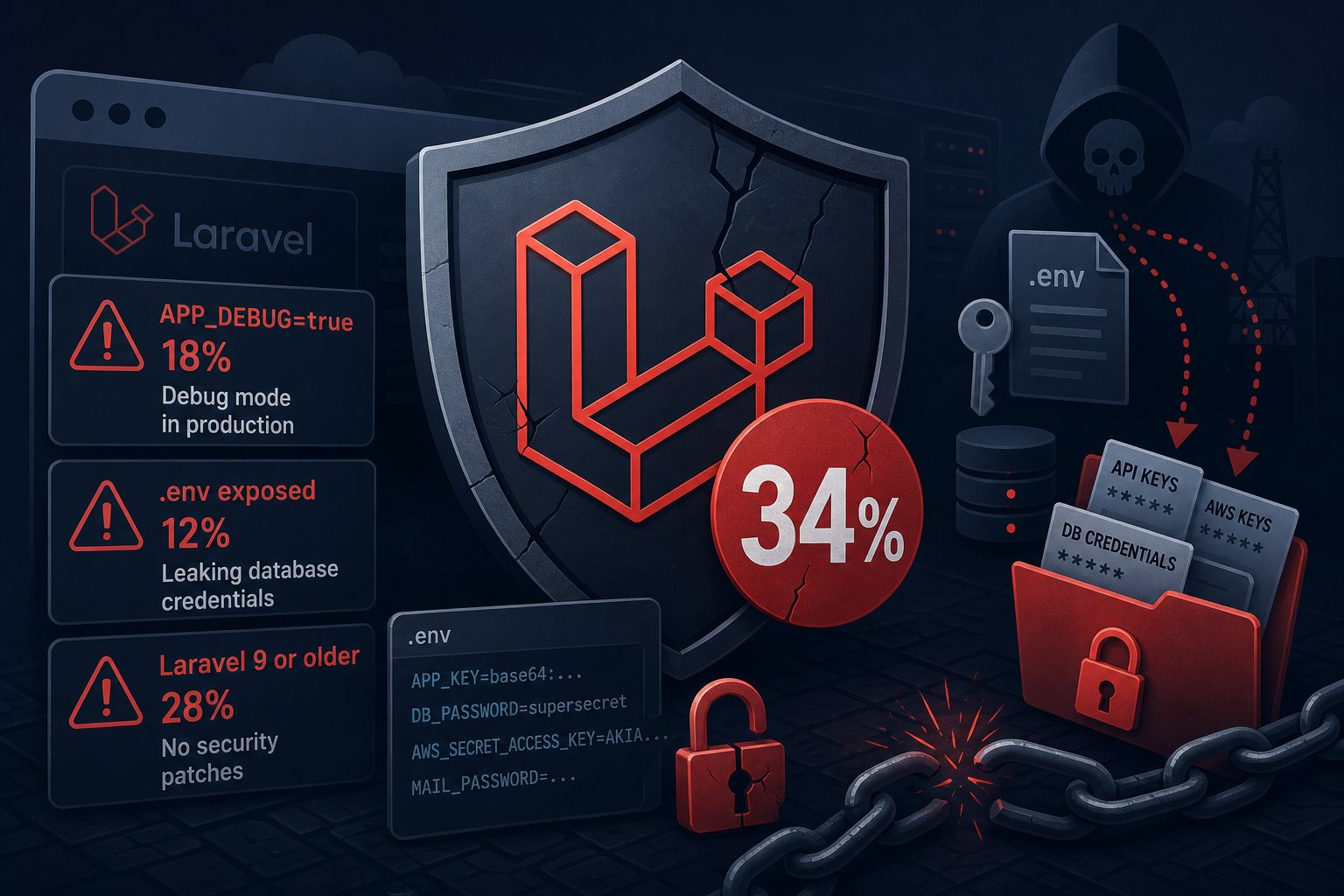
A new industry study analyzed more than 10,000 live Laravel applications using the same non-intrusive HTTP techniques that attackers use, and the numbers are uncomfortable reading. StackShield's State of Laravel Security 2026 report found that 34% of those applications carry at least one critical security issue, the average security score across all tested apps landed at 62 out of 100, and the most common vulnerabilities are not exotic zero-days — they are simple misconfigurations that a developer could fix in an afternoon.
The Most Dangerous Misconfiguration: Debug Mode in Production
Eighteen percent of the applications tested — nearly one in five — had APP_DEBUG=true set in their production environment. This is the single most high-value mistake a Laravel developer can make. When debug mode is on and an unhandled exception occurs, Laravel dumps a full stack trace to the browser: class names, file paths, database connection strings, API keys, encryption secrets, and environment variables — everything an attacker needs to own the application, handed over without them having to touch a single auth prompt. The fix is a one-line change in .env; the consequences of not making it can be catastrophic.
Twelve Percent Are Leaking Database Credentials Right Now
The second alarm from the report: 12% of scanned applications are serving their .env file over HTTP. The .env file is where Laravel stores DB_PASSWORD, APP_KEY, AWS_SECRET_ACCESS_KEY, and any other credential the application depends on. If that file is accessible from a browser — because the web root was misconfigured, because a deployment script landed it in the wrong directory, or because no one added a block rule in Nginx — a scanner will find it in minutes. Automated tools actively search for exposed .env files using Google dorks and direct enumeration; this is not a theoretical risk.
Blocking access is straightforward. On Nginx, a location ~ /\.env { return 403; } block in the server configuration is sufficient. On Apache, a RedirectMatch 403 /\.env line in .htaccess does the same. The file on disk should also be set to mode 600, readable only by the process owner.
Twenty-Eight Percent Are Running Versions That No Longer Get Patches
The version lifecycle problem compounds everything else. Laravel 11 reached end-of-security-support on March 12, 2026. Laravel 9 went end-of-life in early 2024. Despite that, StackShield found 28% of live applications still running Laravel 9 or older — versions that receive no CVE patches, no security backports, and no framework support. Laravel 13 is the current release (shipped March 17, 2026); Laravel 12 holds security support through February 24, 2027. If you are not on one of those two, security fixes are not coming to you.
Upgrading Laravel is not always trivial, but "we will get to it" is not a viable security posture. An application running Laravel 9 on a live production domain is relying entirely on the surrounding infrastructure — WAF rules, hosting-level filtering, server hardening — to compensate for framework-level vulnerabilities that the vendor has already stopped patching.
The May 2026 Supply Chain Attack the Framework Community Is Still Cleaning Up
The StackShield numbers arrived at a particularly bad moment for the Laravel ecosystem. On May 22–23, 2026, an attacker compromised the publishing pipeline for multiple Laravel-Lang packages — widely-used translation libraries present in a large fraction of Laravel projects — and pushed malicious versions across more than 700 package tags. The injected payload, documented by both Snyk and Aikido Security, landed in src/helpers.php and ran automatically via Composer's autoloader. Once running, it harvested .env files, SSH credentials, CI/CD tokens, cloud provider keys, and browser session cookies, encrypted the results with AES-256, and exfiltrated them to an attacker-controlled server.
Packagist removed the malicious versions and temporarily unlisted affected packages, but the window between publication and removal was long enough for automated Composer installs to pull the poisoned packages across production deployments. If your project uses any laravel-lang/* package and you have not run composer audit since May 22, do it now.
What to Fix First
The combination of widespread misconfiguration and active supply chain pressure makes the current moment a good one to run through a quick production hardening pass:
- Confirm
APP_DEBUG=falseandAPP_ENV=productionin your live environment - Block web access to
.envat the server level; verify by making a browser request toyourdomain.com/.envand confirming a 403 response - Check your Laravel version against the support matrix at endoflife.date/laravel; build an upgrade path if you are on version 11 or older
- Run
composer auditto flag known-vulnerable packages in your dependency tree — this catches supply chain compromises that landed before a package was pulled from Packagist - Add
Content-Security-PolicyandPermissions-Policyresponse headers — the report found only 22% and 14% adoption respectively across tested apps, despite both being widely supported - Ensure directory listing is disabled on your web root and that
storage/andbootstrap/cache/directories are not web-accessible
None of these require framework expertise or a major refactor. The StackShield data suggests that most of the 34% exposure rate comes not from insecure code but from deployment steps that got skipped under deadline pressure. For teams that manage multiple Laravel deployments, configuration drift — a single server where APP_DEBUG was left true after a troubleshooting session — is exactly the kind of issue that automated environment monitoring catches before a scanner does. That is why we do it as a matter of routine, not as a reaction to a breach.