Kirki CVE-2026-8206: Anyone Can Take Admin on Half a Million WordPress Sites
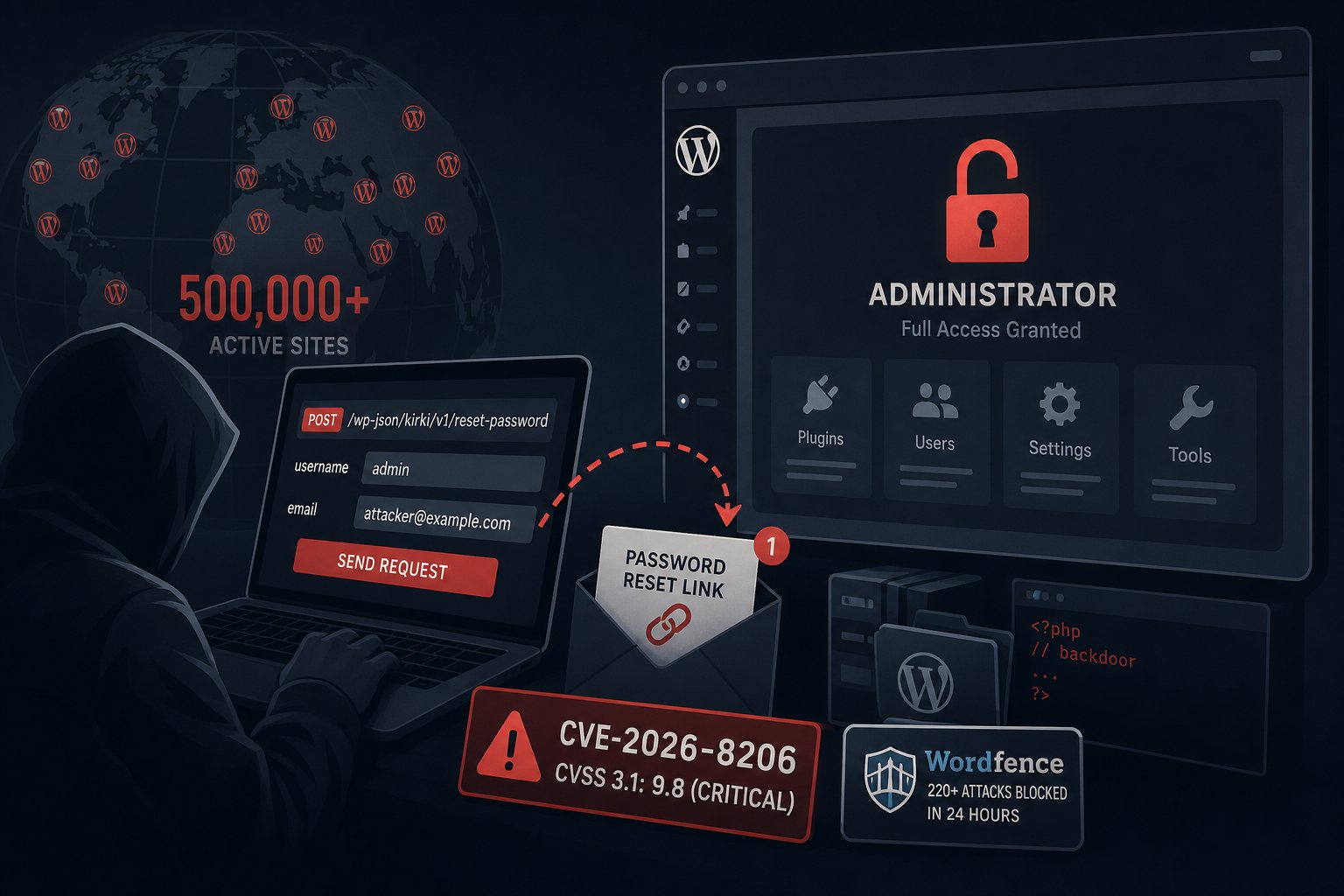
A broken password reset endpoint in the Kirki Freeform Page Builder plugin has handed attackers a reliable, zero-credential path to full administrator control on any of the plugin's 500,000-plus active WordPress installations. CVE-2026-8206 carries a CVSS 3.1 score of 9.8, and Wordfence has confirmed active exploitation — blocking over 220 attack attempts inside a single 24-hour window. The vulnerable endpoint requires nothing more than a known username and a single HTTP POST request.
The patched version is 6.0.7, released June 2, 2026. If your site is running Kirki anywhere in the 6.0.0–6.0.6 range and you have not yet updated, treat this as a fire drill.
How the Flaw Works — and How Little It Takes
The vulnerability lives in a REST API endpoint Kirki exposes for password resets. The intended behavior is straightforward: a user provides their username, and the plugin dispatches a reset link to the email address registered to that account. The broken part: the endpoint accepts an arbitrary email address alongside the username — and sends the reset link there instead. There is no ownership check. There is no verification that the requesting party has any relationship to the account.
In practice, an attacker who can supply a valid admin username receives a fully functional password reset link at an email address they control. They click it, set a new password, and log into your site as administrator. The whole operation takes under a minute and leaves minimal trace in default WordPress logs.
Admin Usernames Are Not Actually Secrets
The attack sounds like it requires inside knowledge — a valid username — but that bar is lower than most site owners realize. The default WordPress installation still creates an admin account, and a significant percentage of sites never rename it. Beyond that, WordPress exposes usernames in at least three default ways: the JSON REST API at /wp-json/wp/v2/users returns a list of authors for published posts; author archive URLs at /?author=1 redirect to slugs that reveal the username; and RSS feeds and post bylines expose display names that frequently match login names.
Attackers enumerate these before anything else. Automated exploit scripts for CVE-2026-8206 start with a username list and iterate. The username is not a meaningful obstacle.
500,000 Sites Is Not a Small Number
Kirki has been in the WordPress ecosystem for years as a Customizer framework, and the 6.0 branch expanded it into a full page builder and site customizer. That history accounts for the large install base — these are not edge-case deployments. According to Wordfence, roughly 40 percent of affected sites remained on an unpatched version at the time of the June 2 disclosure, putting somewhere around 200,000 sites in an immediately exploitable state.
With active exploitation already underway and the attack requiring only one HTTP request, the window between disclosure and compromise is extremely narrow. Exploitation has been confirmed in the wild and the attack volume is rising.
What Attackers Do With Admin Access
A successful exploit is not a partial compromise — it is a complete site takeover. With WordPress administrator access, an attacker can:
- Install arbitrary plugins, including PHP web shells and persistent backdoors
- Create additional hidden administrator accounts to maintain access after the original flaw is patched
- Export the entire WordPress database, including customer data, order history, and hashed passwords
- Inject malicious JavaScript into every page served to your visitors (credential harvesters, drive-by malware, crypto miners)
- Redirect your domain to a phishing site or redirect specific pages to affiliate spam
- Modify or delete content, pages, and media
A common post-exploitation pattern in 2026 has been the creation of rogue administrator accounts with generic-looking names, followed by quiet data exfiltration over days or weeks before any visible damage appears. By the time the defacement or redirect shows up, the real damage is long done.
What to Do Right Now
- Update Kirki to 6.0.7. This is the only real remediation. The patch corrects the password reset logic to verify that the requesting party is the account owner before dispatching any reset link.
- Audit your WordPress administrator accounts. Go to Users → All Users, filter by the Administrator role, and scrutinize anything unfamiliar — especially accounts with generic names, recently created accounts, or email addresses at free providers.
- Check installed plugins and recent file changes. Attackers who already gained access may have installed backdoor plugins or dropped PHP files in
wp-content/uploads. Review your plugin list against what you actually installed and run a file integrity scan with Wordfence or Sucuri. - Rotate admin credentials. If your site ran a vulnerable Kirki version since June 2, treat all admin passwords as potentially reset by someone else. Rotate them and invalidate all active sessions.
- Block username enumeration. Disabling the
/wp-json/wp/v2/usersendpoint and the?author=redirect doesn't patch CVE-2026-8206, but it removes the username harvesting that makes automated attacks fast. Most WAF products and security plugins can handle this with one setting.
The Pattern That Keeps Repeating
CVE-2026-8206 follows the same structural failure as several recent high-severity WordPress vulnerabilities — UpdraftPlus (CVE-2026-10795), Burst Statistics (CVE-2026-8181), Gravity SMTP (CVE-2026-4020). In each case, a feature designed for legitimate site management was reachable without authentication, and the access controls were either missing entirely or implemented incorrectly. The specific mechanism shifts — a logic error in one, a missing capability check in another, a broken ownership check here — but the outcome is always the same: someone else gets to act as your site's administrator.
The practical lesson is not that Kirki is uniquely careless; it is that every plugin that touches authentication, user management, or file access is a potential surface for this class of flaw. Keeping plugins current is now closer to a security control than a maintenance task. At Falcon Internet, our 24x7x365 NOC monitoring flags unpatched critical CVEs on managed sites within hours of disclosure — because the gap between patch availability and active exploitation keeps shrinking.