GPT-5.6 Launches in Three Tiers — Washington Decides Who Gets In First
OpenAI’s newest model family — GPT-5.6, in three variants named Sol, Terra, and Luna — began a limited preview on June 26, 2026. The performance numbers are a genuine step forward. But the way access is being controlled is arguably the bigger story: for the first time, a commercial AI release is gated by the U.S. government, with companies approved case by case before they can touch the API.
Three Tiers, One Clear Pricing Logic
GPT-5.6 lands as the most structured tier split OpenAI has published yet, and the pricing is worth understanding before the gates open.
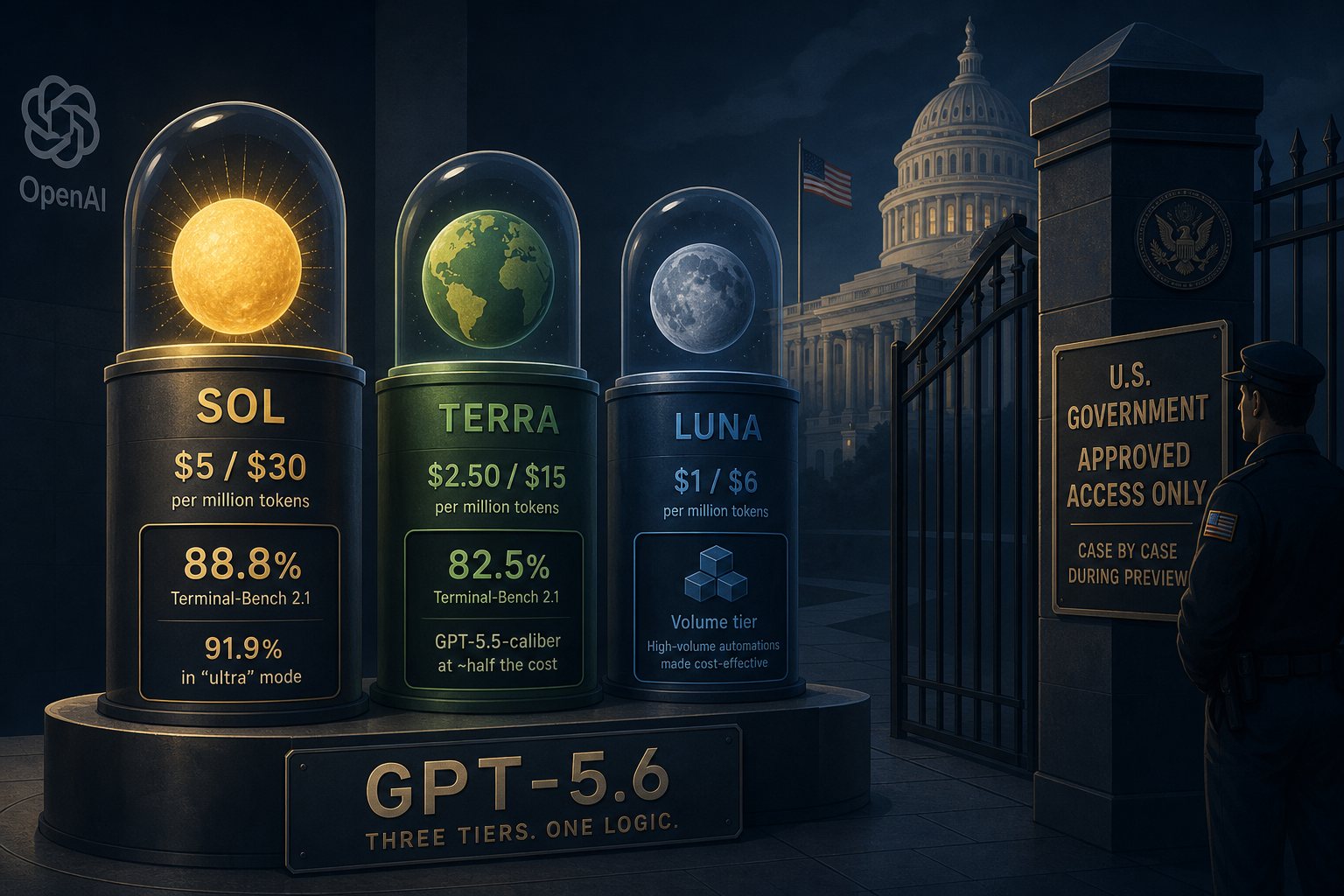
- Sol — $5 per million input tokens, $30 per million output tokens. OpenAI’s flagship: 88.8% on Terminal-Bench 2.1, the hardest publicly available coding and reasoning benchmark in the industry, climbing to 91.9% in “ultra” mode. GPT-5.5 scored 88.0% on the same benchmark.
- Terra — $2.50 input / $15 output per million tokens. Positioned as GPT-5.5-caliber performance at roughly half the cost, benchmarking at 82.5% on Terminal-Bench 2.1. For content generation, classification, summarization, and most customer-facing automations, the gap versus Sol is rarely visible in practice.
- Luna — $1 input / $6 output per million tokens. The volume tier: at those rates, automations that were previously marginal on cost — bulk ticket triage, product description generation at scale, inline content assistance — become straightforward to justify.
If your team currently runs GPT-5.5 for general work, Terra is worth a hard look when access opens. Switching could halve monthly API spend without a meaningful quality regression on most workloads.
What Actually Changed Under the Hood
Three changes matter most for developers building AI into web applications and business workflows.
The context window expanded to roughly 1.5 million tokens — up from around 400,000 effective tokens in GPT-5.5. Sol can now process an entire product knowledge base, a year’s worth of support transcripts, or a large application codebase in a single API call, eliminating the chunking and summarization workarounds that currently add complexity and degrade accuracy on long documents.
Caching got more predictable. GPT-5.6 introduces explicit cache breakpoints — developers define exactly where the context freeze should happen — and cached content now carries a guaranteed 30-minute minimum lifetime. For AI chatbots, document Q&A systems, and support automation hitting the same system prompt repeatedly, this meaningfully tightens billing predictability.
Sol’s “ultra” mode dispatches coordinated subagents rather than running a single large model call. One subagent handles context reading, another runs tool calls or code execution, a third validates the output — Sol synthesizes across them. OpenAI built this specifically for multi-step agentic work: think a coding assistant that reads a repository, writes code, tests it, and iterates without a human in the loop at every step.
Why the Government Is Involved
During the preview period, approximately 20 companies hold API access — each explicitly approved by the U.S. government. Commerce Secretary Howard Lutnick personally called Sam Altman to advise against releasing GPT-5.6 without prior federal sign-off. The legal basis is a June 2, 2026 executive order requiring AI companies to submit frontier models for government review up to 30 days before public release.
The administration’s specific concern is Sol’s cybersecurity capability: its ability to identify software vulnerabilities, evaluate attack targets, and compress the timeline from reconnaissance to intrusion. That concern has technical grounding — a model capable of autonomous multi-step agentic tasks at scale changes the economics of offensive tooling in ways defenders haven’t fully priced in. OpenAI reportedly invested over 700,000 A100-GPU hours in automated red-teaming to harden the model before launch.
OpenAI complied but was pointed about it: “We don’t believe this kind of government access process should become the long-term default. It keeps the best tools from users, developers, enterprises, cyber defenders, and global partners who need them.” Altman told employees that new customer access would be approved “customer by customer” in coordination with the administration for the duration of the preview. Anthropic’s Fable 5 and Mythos 5 models received the same government treatment — the two largest frontier AI labs are, for once, aligned on which side of this particular argument they occupy.
Planning for When Access Does Open
General availability through ChatGPT, Codex, and the public API is expected “in the coming weeks” — most indicators point to July 2026. In the meantime: design current AI integrations against models you can actually reach today, and treat GPT-5.6 as a planned upgrade rather than a live dependency. When Terra opens, benchmark it against your real workloads before cutting over — a 2x cost reduction is significant enough to warrant a few days of parallel testing to confirm prompt behavior carries over cleanly. Luna is worth profiling for any high-volume, latency-tolerant automation where per-token cost is the primary constraint.
At Falcon Internet, the operational lesson here echoes what we see on the infrastructure side: hard dependencies on an endpoint that isn’t generally available yet will surface as outages the moment you flip the switch. Version your AI integrations and validate your fallbacks before GPT-5.6 becomes live traffic for your application.