CVE-2026-19478: GitLab's GraphQL Flaw Lets Anyone Wipe Your Repos
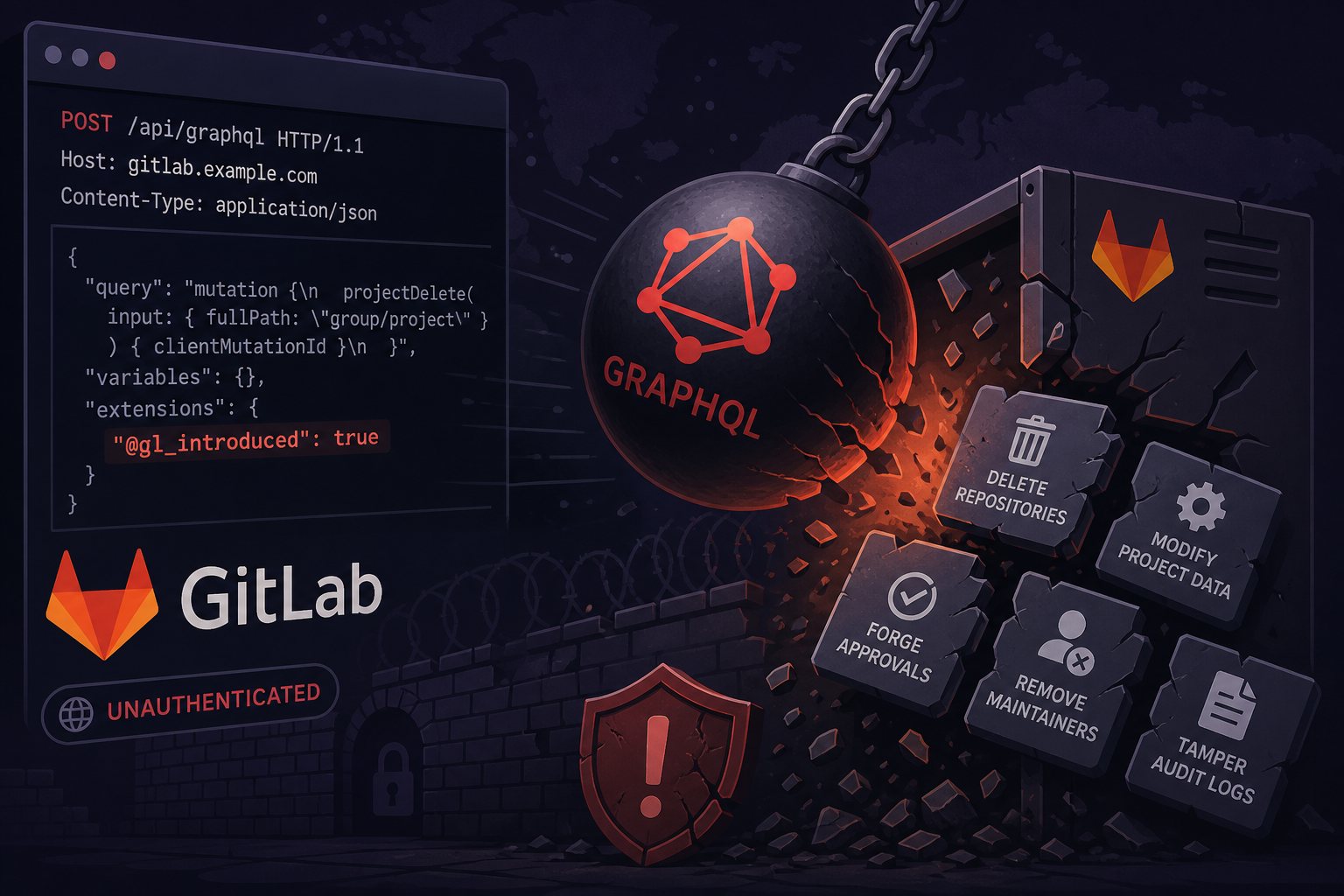
On August 17, GitLab pushed an out-of-band security release to fix CVE-2026-19478, a code-injection defect in its GraphQL API rated CVSS 9.4. The vulnerability is deceptively straightforward: an attacker with no account and no prior access can send a single crafted HTTP request to GitLab's /api/graphql endpoint and delete public repositories, alter project data, forge merge-request approvals, or strip maintainer access — all without touching a login form.
By August 19, two days after the patch dropped, WatchTowr researcher Jake Knott confirmed: "we are already seeing in-the-wild exploitation of this vulnerability hit our global Attacker Eye honeypot network." If you run a self-managed GitLab instance and have not yet updated, assume you are actively being probed.
What the Flaw Actually Does
GraphQL lets clients specify operation directives — metadata instructions that modify how a query or mutation executes. CVE-2026-19478 stems from GitLab's improper handling of one such directive, which the vendor has deliberately withheld from the public advisory to slow weaponization. That restraint bought roughly 48 hours before WatchTowr's researchers reverse-engineered the patch and reproduced the bug from the advisory text alone.
The practical impact is severe. In a single unauthenticated request an attacker can:
- Delete public repositories and their entire commit history
- Modify project metadata, settings, and protected-branch rules
- Forge code-review approvals and remove existing maintainers
- Tamper with audit logs, obscuring the intrusion after the fact
A companion flaw, CVE-2026-19650 (CVSS 7.1), patches a CSRF bug in GitLab's GraphQL multiplex query handler that lets attackers execute mutations via GET requests when a logged-in user visits a malicious page. Both were discovered and reported through GitLab's HackerOne bug bounty program.
Affected Versions
Every self-managed GitLab CE and EE installation in the following ranges is vulnerable:
- 18.2 through 18.11.10
- 19.0.0 through 19.0.7
- 19.1.0 through 19.1.5
- 19.2.0 through 19.2.3
Fixed releases are 18.11.11, 19.0.8, 19.1.6, and 19.2.4. GitLab.com and GitLab Dedicated are already running patched versions — users on those hosted tiers need no action.
The 48-Hour Exploitation Window — and Why It Keeps Shrinking
Security researchers have noted something uncomfortable in CVE-2026-19478's timeline: it took less than 48 hours for attackers to move from patch release to live exploitation. That window is consistent with a pattern eSecurity Planet and others have flagged in 2026: AI-assisted analysis is compressing the gap between vendor disclosure and weaponized exploit. What once took a competent attacker a week now takes an afternoon.
For GitLab specifically, this is the latest in a string of GraphQL-layer vulnerabilities patched in 2026. GraphQL's expressive query model makes it a powerful API, but it also creates a wide attack surface — directive handling, multiplex queries, and mutation authorization all require careful server-side enforcement that's easy to get subtly wrong. Any team running self-managed GitLab should treat GraphQL endpoint exposure as a first-class security concern going forward.
The Supply-Chain Angle Small Businesses Often Miss
Most coverage of CVE-2026-19478 focuses on the deletion risk — and yes, losing a repository is painful. But the subtler threat is the integrity risk. An attacker who can forge merge-request approvals and manipulate audit logs can inject malicious code into a project while making the version-control history look clean. For any team whose GitLab instance feeds a CI/CD pipeline into a customer-facing application, that's a software supply chain attack waiting to happen.
If you have public repositories on a self-managed instance — open-source projects, client-facing SDKs, public documentation builds — you are directly exposed. Private repositories require a logged-in session and appear to be out of scope for this specific flaw, but restricting the GraphQL endpoint regardless is sound hygiene.
What to Do Right Now
1. Patch immediately. Update to 18.11.11, 19.0.8, 19.1.6, or 19.2.4, whichever matches your branch. There is no documented workaround that adequately substitutes for the fix.
2. Hunt your logs. WatchTowr advises searching web server and application logs for requests containing @gl_introduced — a directive string associated with the flaw. Any hit before your patch date is worth investigating as a potential compromise indicator.
3. Restrict /api/graphql at the network edge. If your self-managed instance doesn't need anonymous GraphQL access, block unauthenticated requests to that endpoint via your reverse proxy or WAF. On nginx this is a straightforward location-block auth_request or allow/deny rule. On a perimeter firewall, an allowlist of known IP ranges plus a default-deny achieves the same effect.
4. Audit recent repository changes. Check for unexpected deletions, maintainer removals, or approval-status changes on merge requests from the past week. Given exploitation started August 19, that's the window of active risk for unpatched instances.
5. Consider Zero Trust access controls for your GitLab instance. If your development team uses a VPN or identity-aware proxy to reach internal tools, putting GitLab behind that boundary dramatically shrinks the attack surface — even for future GraphQL-layer bugs GitLab hasn't found yet.
Context: GraphQL as a Growing Attack Surface
CVE-2026-19478 is not the first, second, or third GraphQL-related vulnerability patched in GitLab in 2026. That pattern is worth paying attention to. GraphQL is increasingly standard across modern web applications — if you or your development team use it in your own projects, the same class of authorization-bypass bugs (directive injection, improper mutation scoping, introspection leakage) can appear in your code. The OWASP API Security Top 10 has flagged GraphQL-specific risks since 2023; the GitLab incidents give those abstract warnings a concrete cost.
At Falcon Internet, we run infrastructure audits that specifically check whether GraphQL and other API endpoints are properly gated — it's the kind of exposure that rarely shows up in a quick scan but matters enormously when an attacker goes looking. If your team self-hosts any Git platform or application with a GraphQL API, now is a good moment to verify your endpoint authorization is where you think it is.