CVE-2026-86218: When Your MSP's RMM Tool Becomes the Attack Vector
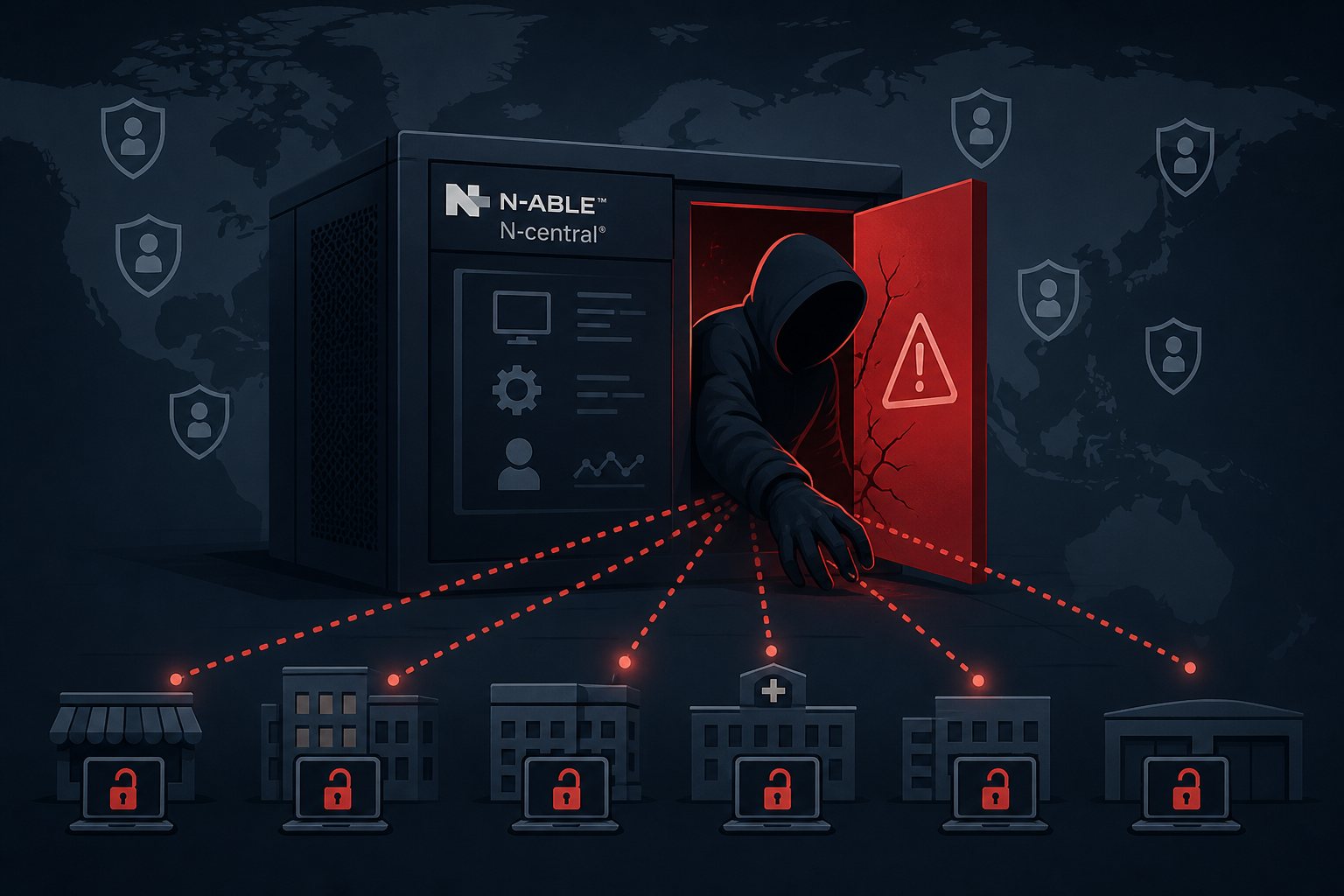
If your business uses a managed service provider, you probably assume that someone else is watching the security of the tools that watch your systems. CVE-2026-86218 is a timely reminder to verify that assumption. N-able's N-central — the remote monitoring and management (RMM) platform powering a large chunk of the MSP industry — has been patched four times in five weeks, the latest for a CVSS 10.0 pre-authentication remote code execution flaw that attackers were already actively exploiting before the hotfix shipped.
CISA added CVE-2026-86218 to the Known Exploited Vulnerabilities catalog and gave federal civilian agencies until September 11, 2026 to remediate. That deadline is today. If your MSP is still running a vulnerable version, it's not just their problem.
A Month of Holes
The story starts in early August, when N-able began shipping a series of emergency hotfixes for N-central 2026.3. The first two patches addressed CVE-2026-86206 (a CVSS 6.9 access control filter bypass against internal N-central APIs) and CVE-2026-86207 (a CVSS 7.7 authentication bypass against the management interface). Researchers at Rapid7 Labs and Huntress discovered that these two could be chained: by abusing N-central's trust of loopback-origin requests to its Jetty backend, an unauthenticated remote attacker could bypass Envoy's edge proxy, reach privileged internal endpoints, and create a new System Administrator account outright — no credentials required. Hotfix 3 (build 2026.3.1.13) addressed that pair.
CVE-2026-86218 arrived days later. It's a static code injection vulnerability, classified at CVSS 10.0 — the ceiling — and it enables pre-authentication remote code execution directly on the N-central server. N-able released Hotfix 4 (build 2026.3.1.14) on September 5 and disclosed the flaw on September 6. Huntress triggered its own rapid-response investigation after a customer's fully patched N-central environment was compromised on September 4 — meaning exploitation predated the public advisory by at least 48 hours. Because N-central's on-appliance logs rotate aggressively, Huntress could not definitively confirm which CVE the attacker used, though the CVSS 10.0 RCE is the working hypothesis. What they could confirm: unauthorized administrators were created with known N-able email addresses appended with .invalid strings — a behavioral fingerprint worth hunting for in your own logs if you run N-central.
Why MSP Tools Are the Crown Jewels
N-central exists to let MSPs manage thousands of client endpoints from one console. That's the product's entire value: a single pane of glass across dozens or hundreds of client environments, with the ability to push software, run scripts, access desktops, rotate credentials, and deploy configuration changes at scale. The same power that makes RMM tools indispensable to MSPs also makes them extraordinarily dangerous when compromised.
This dynamic played out in full during the July 2021 Kaseya VSA attack, where ransomware operators exploited a zero-day in a competing RMM platform to deploy encryption payloads across roughly 1,500 managed businesses in a single wave. The attacker didn't need to compromise each victim individually — they compromised the tool that had standing access to all of them. CVE-2026-86218 presents the same structural risk. An attacker who achieves pre-auth RCE on an N-central server doesn't get one company's network. They get a management foothold into every client that MSP serves.
Huntress estimates approximately 1,500 on-premises N-central servers remain internet-facing as of early September. Even a modest exploitation rate against that population represents hundreds of downstream business networks at risk.
Who Is Affected and What Needs to Happen
CVE-2026-86218 affects all N-central versions before 2026.3.1.14. N-able's cloud-hosted N-central was patched server-side and does not require action from MSPs using that delivery model. On-premises deployments are the exposure, and they need Hotfix 4 applied immediately.
- If you run N-central on-premises: Apply HF4 (build 2026.3.1.14) now. Versions running HF3 or earlier remain fully vulnerable to CVE-2026-86218 even if HF3 addressed the previous pair.
- Audit administrator accounts: Review the N-central admin account list for any accounts with unexpected email formats — particularly anything containing
.invalid— and any accounts created in the past 30 days that you don't recognize. - Review connection logs: N-able specifically flagged the IP range 23.234.64.0/18 as a source of active exploitation attempts. Check firewall and Envoy proxy logs for inbound connections from that range.
- Restrict exposure: N-central's management interface should not be internet-facing without a VPN or zero-trust enforcement layer. If yours is, restrict it now regardless of patch status.
The Question Small Businesses Should Be Asking Their MSP
If you don't run N-central directly — if you have an MSP that manages your servers, workstations, or cloud environments — the appropriate response isn't to shrug this off because it's your provider's problem. It partly is. But ask your MSP point-blank: which build of N-central are you running, and when was HF4 applied? A good MSP will answer that in seconds. A concerning one will need to go find out.
The harder conversation is about whether your MSP's own security posture is part of your vendor risk assessment. Most small businesses never ask this question. The 2021 Kaseya incident and this month's N-central sequence are both arguments that it belongs on the list alongside vendor financial health and SLA response times. How an MSP handles a flurry of emergency zero-days in their own tooling tells you a lot about how they handle yours.
We've drilled the Kaseya scenario with clients for years — it's part of why we test restore procedures rather than just assuming backups exist. Four critical patches in five weeks from a single platform vendor is the kind of signal worth paying attention to regardless of which MSP or toolchain you use.