CVE-2026-55200: CVSS 9.2 libssh2 Bug Has a PoC — Patch Before Attackers Do
A proof-of-concept exploit for CVE-2026-55200 went public on June 27–29, 2026, and it targets a flaw that sits quietly inside software nearly every Linux server runs: libssh2. With a CVSS 4.0 score of 9.2 and a working exploit now in the wild, the window for leisurely patching has closed.
What libssh2 Is and Why It’s Everywhere
libssh2 is a C library that implements the SSH2 protocol on the client side. It is not the OpenSSH daemon that accepts inbound connections — it is the component that lets software make SSH connections. That distinction matters enormously here.
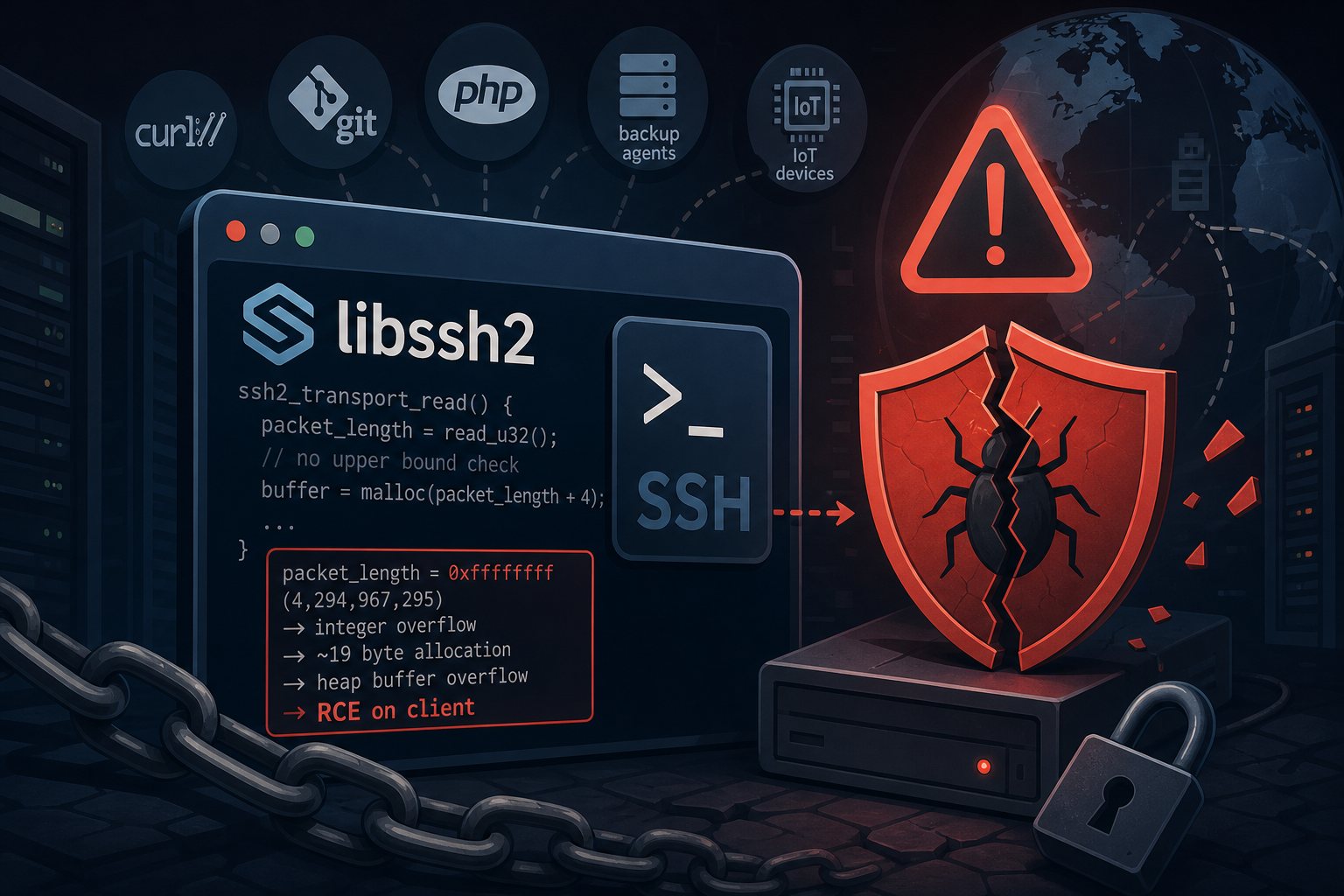
It is embedded — often statically compiled — inside curl, Git, PHP’s ssh2 extension, dozens of backup agents, firmware updaters, automation frameworks, and IoT appliances. Every release up to and including 1.11.1 is vulnerable. Because many builds link it statically, distro package updates that patch your system’s shared libssh2.so will miss those copies entirely.
What the Flaw Does
The vulnerability lives in ssh2_transport_read() inside transport.c, the function that parses incoming SSH packets during the handshake. The function reads the attacker-controlled packet_length field from the server’s response and rejected only values below 1 — it enforced no upper bound.
The consequence is a textbook CWE-680: integer overflow to buffer overflow. An attacker-controlled value of 0xffffffff (about 4.3 billion) wraps around in 32-bit arithmetic, causing libssh2 to request a heap allocation of roughly 19 bytes while subsequently writing the full, oversized packet into it. That out-of-bounds heap write is the primitive that enables remote code execution on the connecting client — meaning the server kills the process making the SSH connection, not the other way around.
No credentials are required. No user interaction is needed. The only prerequisite is that a vulnerable client connects to a malicious or already-compromised SSH endpoint. The published PoC includes an arithmetic verifier, a malicious SSH server scaffold, and a controlled RCE harness demonstrating successful exploitation.
The Companion Vulnerability: CVE-2026-55199
Researchers also disclosed CVE-2026-55199 (CVSS 8.2) alongside the critical RCE. This second flaw allows a malicious SSH server to supply crafted extension count values during key exchange, trapping the connecting client in a computation loop exceeding 60 seconds — a denial-of-service that can tie up backup jobs, deployment pipelines, or monitoring agents indefinitely. It affects the same libssh2 ≤1.11.1 versions.
Where You’re Likely Exposed
Think through any service on your infrastructure that opens an outbound SSH connection:
- PHP applications using the
ssh2_*functions (SFTP uploads, remote command execution) - curl when fetching
sftp://URLs — common in deployment scripts and cron jobs - Git when cloning or fetching over SSH remotes
- Backup software that pushes snapshots to remote SSH targets (rsync over SSH, Duplicati, Borg, custom scripts)
- Deployment tools and CI/CD runners that SSH into servers to deploy code
- Monitoring agents that poll remote hosts via SSH
The risk is highest when any of the above connects to a third-party server, a customer environment, or a cloud endpoint you do not fully control. A compromised remote host can silently weaponize the connection back against your infrastructure the moment your client touches it.
Patch Status and What to Do Now
The upstream fix — commits 97acf3d and 1762685 via PR #2052 — was merged on June 12, 2026. As of this writing, no new official libssh2 version has been tagged. Distributions are backporting the patch independently, so the action plan looks like this:
- Update your OS packages immediately. Run
apt-get update && apt-get upgrade libssh2-1(Debian/Ubuntu) ordnf update libssh2(RHEL/Fedora). Vendor advisories from major distros are expected imminently if not already published. - Audit statically linked copies. Check compiled-in versions of PHP, curl builds, and any backup agent binaries. Static links do not update with your distro packages — you may need to rebuild or update those tools independently.
- Restrict outbound SSH by IP where possible. Firewall rules that limit which SSH endpoints your servers can reach reduce the attack surface while you patch.
- Review third-party SSH endpoints. If any of your software connects to an SSH server you do not own — a vendor’s SFTP drop, a customer server, a hosting partner — treat that endpoint as untrusted until you confirm it is clean.
- Monitor for anomalies. Watch for unexpected crashes in PHP-FPM, backup agents, or curl-based jobs. Heap corruption exploitation is often noisy before it succeeds.
The fact that CISA’s Known Exploited Vulnerabilities catalog does not yet list CVE-2026-55200 means active exploitation has not been confirmed in the wild. But a working PoC is now public, and the gap between “PoC drops” and “mass scanning begins” has historically been measured in hours to days.
The Bigger Picture
This vulnerability illustrates a recurring and underappreciated risk class: the security of your server depends not only on what connects to it, but on what it connects to. Most hardening checklists focus on locking down inbound attack surface — firewalls, fail2ban, SSH key enforcement. Outbound SSH clients on the same machine receive far less scrutiny, and this is precisely where CVE-2026-55200 bites.
At Falcon Internet, we run 24x7x365 NOC monitoring precisely because situations like this do not wait for business hours. When a CVSS 9.2 vulnerability drops a working exploit on a Friday, the patch window is already open.