CVE-2026-18577: Auth Bypass in N-central Puts Every MSP Client at Risk
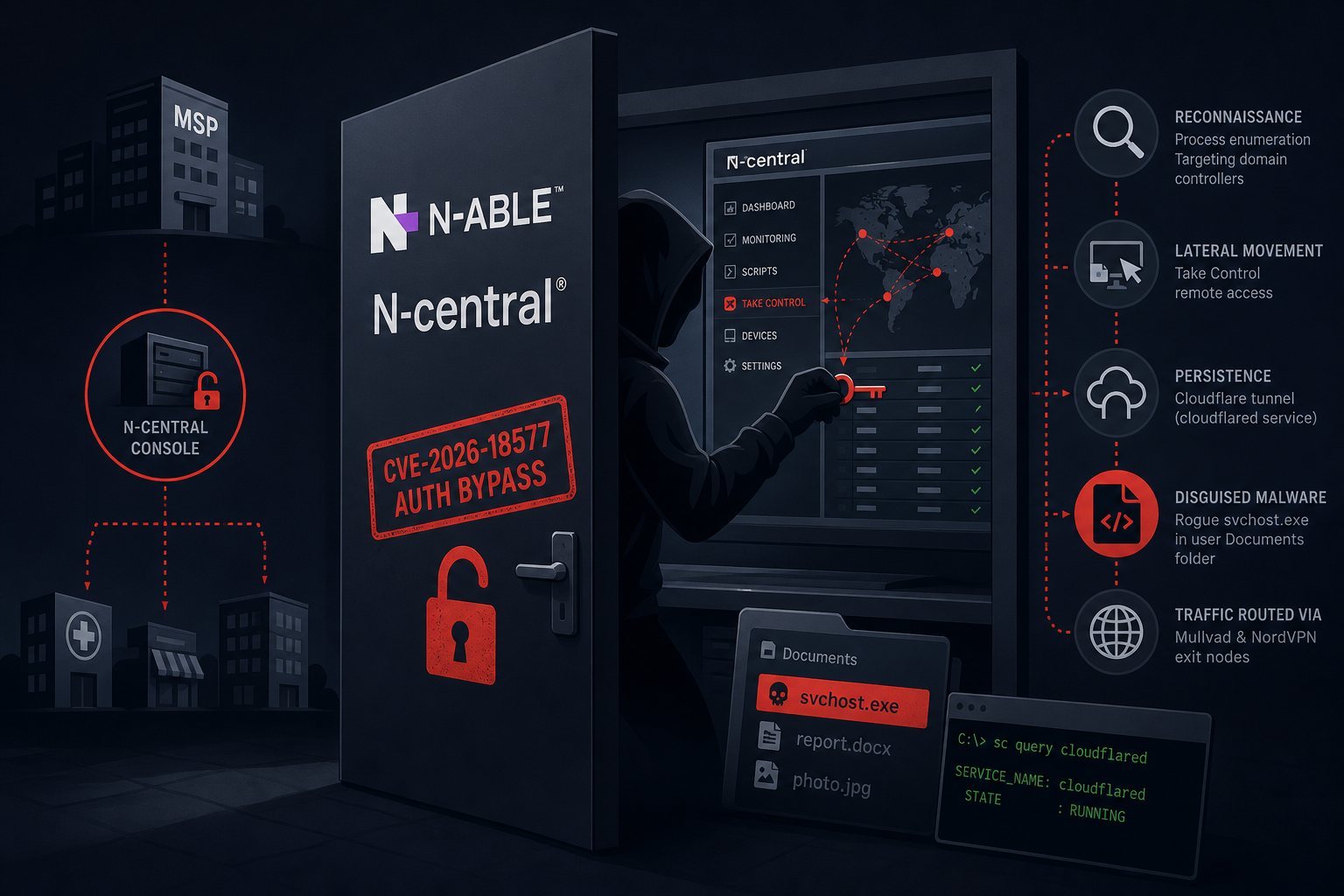
On July 31, N-able noticed something odd: a surge in unusual licensing anomalies across on-premises N-central deployments. Within 48 hours, the company had traced the cause to a newly discovered authentication bypass, assigned it CVE-2026-18577, pushed a hotfix, and watched CISA add it to the Known Exploited Vulnerabilities catalog — all while attackers were already inside compromised consoles, using the platform's own tools against its customers. Federal agencies have until August 6 to patch. Everyone else should treat that deadline as their own.
The Platform in the Crosshairs
N-able's N-central is a Remote Monitoring and Management (RMM) platform used by Managed Service Providers — the IT shops that handle patching, monitoring, scripting, and remote access for small and mid-size businesses. By design, N-central has privileged reach over everything it monitors: it can run scripts, push software, open remote sessions, and change configurations across every machine under management, across every client the MSP serves.
That architecture is exactly what makes RMM platforms such an attractive target. Compromising a single N-central instance doesn't get you one company. It can get you every company that MSP manages. This is the supply-chain risk model that ransomware operators have been pursuing for years, and CVE-2026-18577 handed them a working key.
From Incomplete Patch to Actively Exploited
The vulnerability's lineage matters. Earlier in 2026, N-able patched CVE-2026-18556, an authentication bypass affecting N-central. The fix was real but incomplete — it left an alternate authentication path open. When exploitation activity started generating licensing anomalies at the end of July, N-able's security team found the secondary vector, assigned it CVE-2026-18577 (authentication bypass using an alternate path or channel, CWE-288, CVSS 8.2), and on August 2 released hotfix version 2026.3.1.7.
Cloud-hosted N-central instances received the update automatically. On-premises deployments require a manual upgrade — and as of August 3, Huntress researchers found that 55.6% of monitored N-central cloud servers were still running vulnerable versions. That gap between patch availability and patch reality is the window attackers are working in right now.
What the Attack Chain Looked Like
After bypassing authentication to reach the N-central admin console, attackers followed a deliberate playbook:
- Reconnaissance: process enumeration on managed systems, with particular focus on domain controllers — exactly the assets worth prioritizing for lateral movement or ransomware staging.
- Lateral movement: N-central's built-in Take Control remote-access feature, repurposed as the attack's movement tool. The legitimate capability became the vehicle.
- Persistence: attackers registered a Cloudflare tunnel service (
cloudflared) on compromised managed endpoints. This is the detail that makes this incident particularly ugly — once the tunnel is in place, it survives a password reset, a firewall rule change, and even a hotfix to N-central itself. Revoking access to the RMM console does not remove the tunnel. - Disguised malware: a rogue
svchost.exeplanted in user Documents folders. A realsvchost.exelives in System32 — one that shows up in a user's Documents folder is not Windows.
All observed traffic was routed through Mullvad and NordVPN exit nodes. Known-malicious IP addresses identified by Huntress include 173.249.252[.]200, 87.249.138[.]34, 37.19.210[.]32, 68.235.46[.]214, 37.153.90[.]88, and 92.118.112[.]181. The use of commercial VPN services and purpose-built persistence mechanisms points to a deliberate, patient operation — not opportunistic scanning.
What This Means for Small Businesses
Most small businesses don't run N-central. Their MSP does, on their behalf. That's exactly the exposure. Whether your organization is at risk from CVE-2026-18577 depends on whether the company managing your IT infrastructure patched their platform in the last 72 hours — not on anything your own team did or didn't do.
This is worth a direct conversation with your MSP: Are you running N-central? If so, are you on version 2026.3.1.7? If they can't answer that quickly, that's information too. The blast radius of an RMM compromise isn't limited to one endpoint or one site — it's every device the MSP has under management, often including servers, workstations, backups, and network gear.
What to Do Right Now
For MSPs and IT teams operating N-central:
- Patch immediately: upgrade to version 2026.3.1.7. Cloud-hosted instances should be auto-updated — confirm this rather than assuming it.
- Hunt for Cloudflare tunnel persistence: look for a
Cloudflaredservice on managed endpoints. If you find one you didn't install, treat the system as compromised. - Check for disguised malware: a
svchost.exein any user's Documents folder is an indicator of compromise. The real one belongs in C:\Windows\System32\ — not in user profile directories. - Review session logs: N-central Take Control session logs live at
C:\ProgramData\GetSupportService_N-Central\Logs\. Audit for unexpected remote sessions, particularly any using an "MSP Support" account you don't recognize. - Firewall the console: N-central's administrative interface should not be reachable from the open internet. If it currently is, close that exposure now — VPN-only access is the correct posture for any RMM platform.
- Enforce MFA: on all N-central accounts, without exception. Authentication bypasses are more contained when the account being bypassed has a second factor protecting it.
- Block known-malicious IPs at the perimeter: 173.249.252.200, 87.249.138.34, 37.19.210.32, 68.235.46.214, 37.153.90.88, and 92.118.112.181.
CISA's six-day deadline for federal agencies (August 6) is a useful calibration for urgency. Federal patch timelines for KEV entries are intentionally aggressive because the agency has assessed active exploitation as confirmed. Private-sector MSPs should use the same clock.
At Falcon Internet, 24x7x365 NOC monitoring means our team catches KEV additions the day they land — because when an RMM platform becomes an attack vector, the time between disclosure and exploitation is measured in hours, not weeks.