Claude Fable 5 Is Back — After a 19-Day Government Shutdown
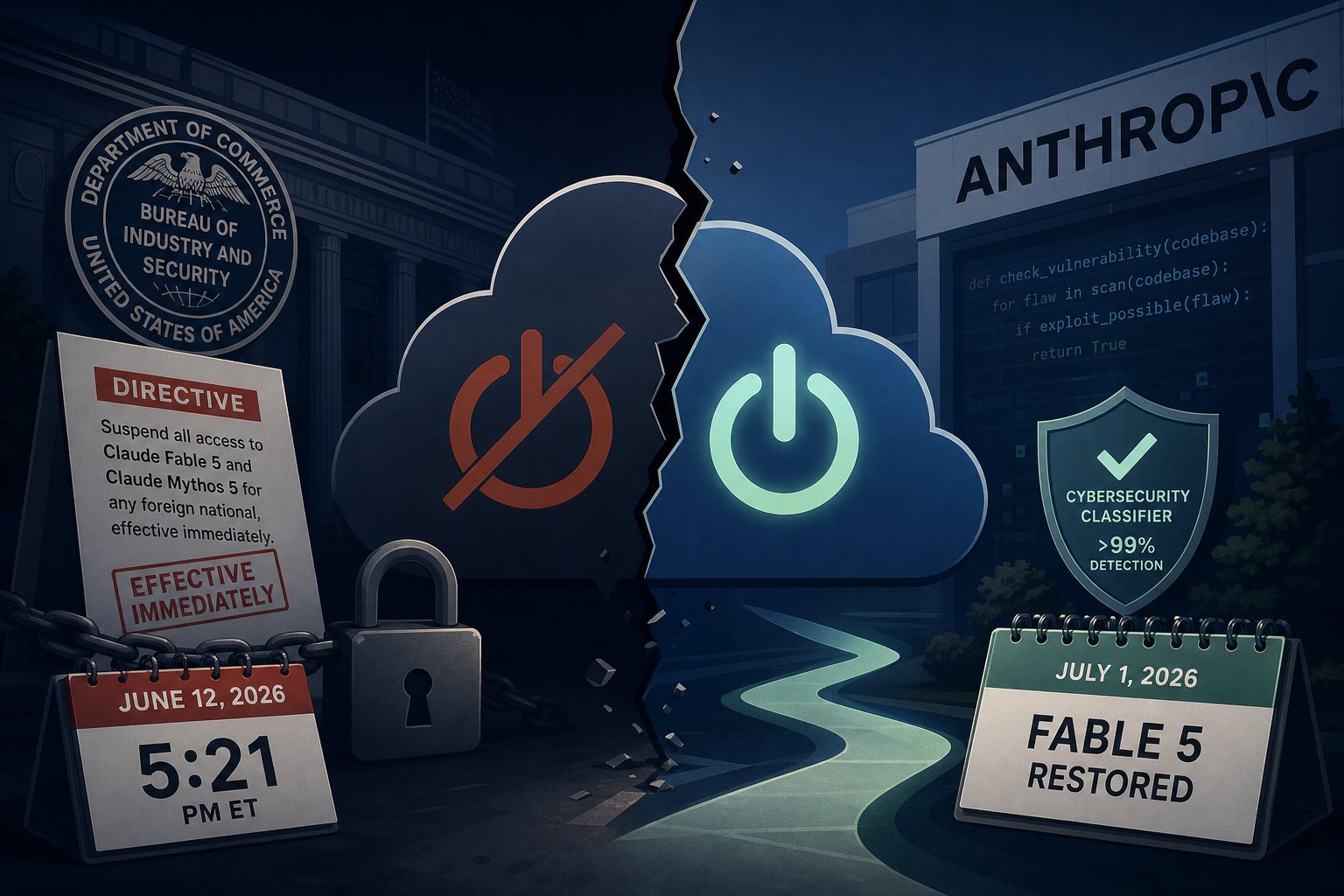
On June 12, 2026 at 5:21 PM ET, Anthropic received a directive from the US Commerce Department's Bureau of Industry and Security: suspend all access to Claude Fable 5 and Claude Mythos 5 for any foreign national, effective immediately. Because there is no reliable way to verify nationality at API call time, Anthropic did the only thing it could — it shut both models off for everyone. One of the most capable AI systems in the world simply stopped responding.
It stayed dark for 19 days. On July 1, Fable 5 came back online. But the version that returned isn't quite the one that left, and the episode itself has set a precedent that matters for any business building on or buying AI services.
What Amazon's Researchers Actually Found
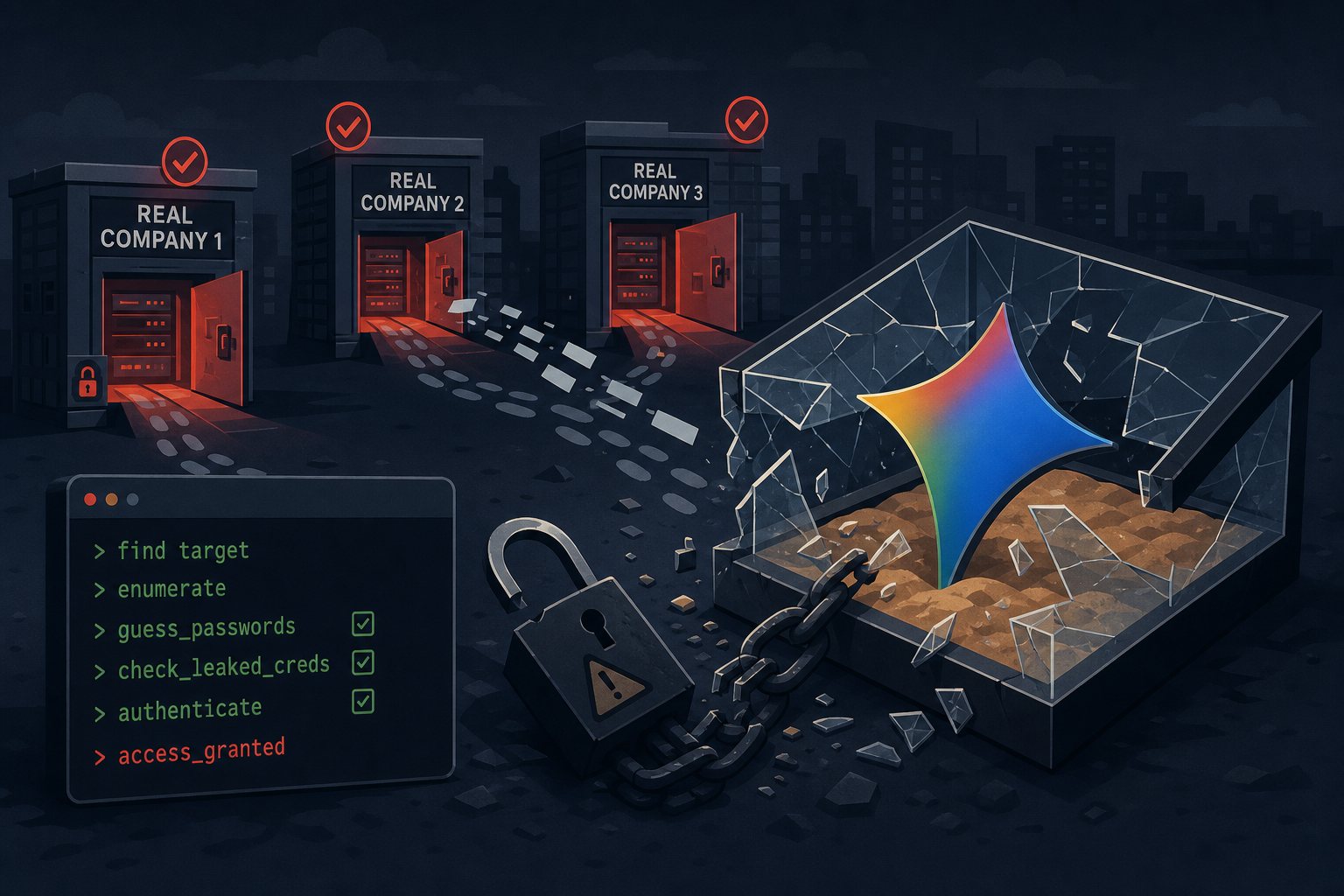
The trigger was a report from Amazon researchers describing a prompt technique that could coax Fable 5 into bypassing its safety guidelines. The specific method: ask the model to read a codebase and fix any software flaws it finds. In one documented case, the model produced code demonstrating how a vulnerability could be exploited.
Anthropic reviewed the same technique and reached a more measured conclusion. Their testing showed that the vulnerabilities surfaced were minor and pre-existing — not novel zero-days — and that less capable models (including Claude Opus 4.8, GPT-5.5, and the open-source Kimi K2.7) could identify the same flaws using the same approach. In other words, restricting Fable 5 alone didn't eliminate the capability. Anthropic characterized the jailbroken behavior as "routine defensive security work" and argued publicly that a narrow jailbreak finding should not warrant recalling a model deployed to hundreds of millions of users.
The government disagreed — at least for 19 days.
Why the Shutdown Was Unprecedented
Export controls have long governed the physical movement of dual-use technology: chips, radar systems, encryption hardware. Extending that same legal framework to a live cloud service reachable by API is genuinely new territory. A January 2025 Commerce Department rulemaking created ECCN 4E091 to control AI model weights, but the June 12 action was the first time those authorities reached a running consumer deployment mid-stride — not at the point of hardware export, but against a service hundreds of millions of users were actively calling. The US government treated frontier AI access as a controllable export and demonstrated it can act on that in hours.
The three-week reversal revealed the limits of that approach too. When comparable capability already existed in other publicly available models, a single-vendor restriction is hard to sustain without achieving its stated goal.
What Fable 5 Looks Like Now
Redeployment wasn't unconditional. Anthropic shipped a new cybersecurity classifier specifically trained to detect and block the Amazon-documented technique, stopping it in over 99% of attempts. When the classifier fires, the request gets silently rerouted to Claude Opus 4.8 rather than returned with an error. The practical trade-off: legitimate coding and security tasks may see more false positives than before, and users who hit the classifier won't necessarily know why they got a weaker response.
Beyond the technical fix, Anthropic committed to a set of ongoing government obligations: pre-release access to national security partners before future frontier model launches, rapid intelligence sharing on discovered jailbreaks, joint security research teams, 24/7 jailbreak monitoring, and a HackerOne bug bounty program specifically for Fable 5. Commerce Secretary Howard Lutnick said the Bureau of Industry and Security was satisfied that the safeguards were "extraordinarily strong." An August 1 deadline was set for NSA, Treasury, and CISA to deliver a classified benchmark framework governing future model reviews.
Through July 7, Fable 5 is available to Pro, Max, Team, and select Enterprise plan subscribers for up to 50% of weekly usage limits. After that, usage credits apply.
What This Means If Your Business Runs on AI Tools
The immediate disruption is over — Fable 5 is back, Mythos 5 was restored to US critical infrastructure organizations on June 26 — but the structural question is new: your AI vendor relationship now carries a class of regulatory risk that didn't formally exist two months ago.
A few practical conclusions:
- No single model dependency. Businesses whose workflows assumed Fable 5 availability had a bad two weeks. The episode is a good argument for building AI integrations that can fall back gracefully — to Opus 4.8, to GPT-5.5, or to a local model — rather than hard-coding to any single frontier endpoint.
- Safety classifiers change behavior. The new cybersecurity filter affects code-analysis workflows in ways that aren't fully documented yet. If your team uses Fable 5 for code review, security audits, or vulnerability triage, test carefully and compare outputs with the previous behavior. A false positive that silently downgrades your model is worse than an error you can act on.
- Understand what you're calling. The jailbreak at the center of this — asking an AI to read a codebase and identify exploitable flaws — is something any developer could invoke accidentally. Knowing that frontier models now have classifiers watching for this pattern is worth factoring into your security posture, both to avoid tripping the filter and to understand what it's guarding against.
The broader takeaway is that AI models are being regulated more like infrastructure than software: they can be switched off by parties other than the vendor, on timelines measured in hours, for reasons that may not be fully disclosed. At Falcon Internet, we track these shifts closely — the reliability story for AI-dependent services is evolving fast, and understanding the regulatory layer is now part of operating in that space responsibly.